
Every living thing on Earth is made up of cells... Mostrar más
 Science
 Irish
Irish English
 Geography
Inscríbete para ver los apuntes¡Es gratis!
Acceso a todos los documentos
Mejora tus notas
Únete a millones de estudiantes
Asignaturas
Triangle Congruence and Similarity Theorems
Triangle Properties and Classification
Linear Equations and Graphs
Geometric Angle Relationships
Trigonometric Functions and Identities
Equation Solving Techniques
Circle Geometry Fundamentals
Division Operations and Methods
Basic Differentiation Rules
Exponent and Logarithm Properties
Mostrar todos los temas
Human Organ Systems
Reproductive Cell Cycles
Biological Sciences Subdisciplines
Cellular Energy Metabolism
Autotrophic Energy Processes
Inheritance Patterns and Principles
Biomolecular Structure and Organization
Cell Cycle and Division Mechanics
Cellular Organization and Development
Biological Structural Organization
Mostrar todos los temas
Chemical Sciences and Applications
Atomic Structure and Composition
Molecular Electron Structure Representation
Atomic Electron Behavior
Matter Properties and Water
Mole Concept and Calculations
Gas Laws and Behavior
Periodic Table Organization
Chemical Thermodynamics Fundamentals
Chemical Bond Types and Properties
Mostrar todos los temas
European Renaissance and Enlightenment
European Cultural Movements 800-1920
American Revolution Era 1763-1797
American Civil War 1861-1865
Global Imperial Systems
Mongol and Chinese Dynasties
U.S. Presidents and World Leaders
Historical Sources and Documentation
World Wars Era and Impact
World Religious Systems
Mostrar todos los temas
Classic and Contemporary Novels
Literary Character Analysis
Rhetorical Theory and Practice
Classic Literary Narratives
Reading Analysis and Interpretation
Narrative Structure and Techniques
English Language Components
Influential English-Language Authors
Basic Sentence Structure
Narrative Voice and Perspective
Mostrar todos los temas
2
•
Actualizado May 4, 2026
•
Every living thing on Earth is made up of cells... Mostrar más
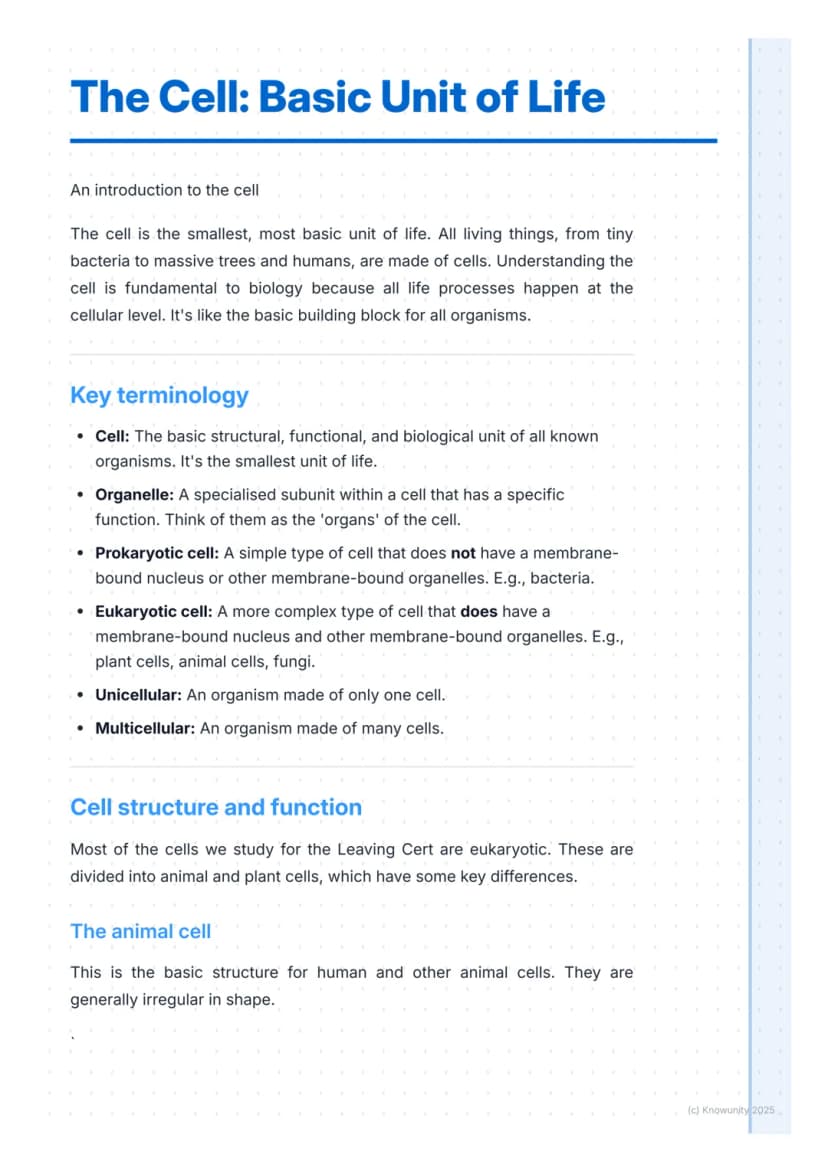
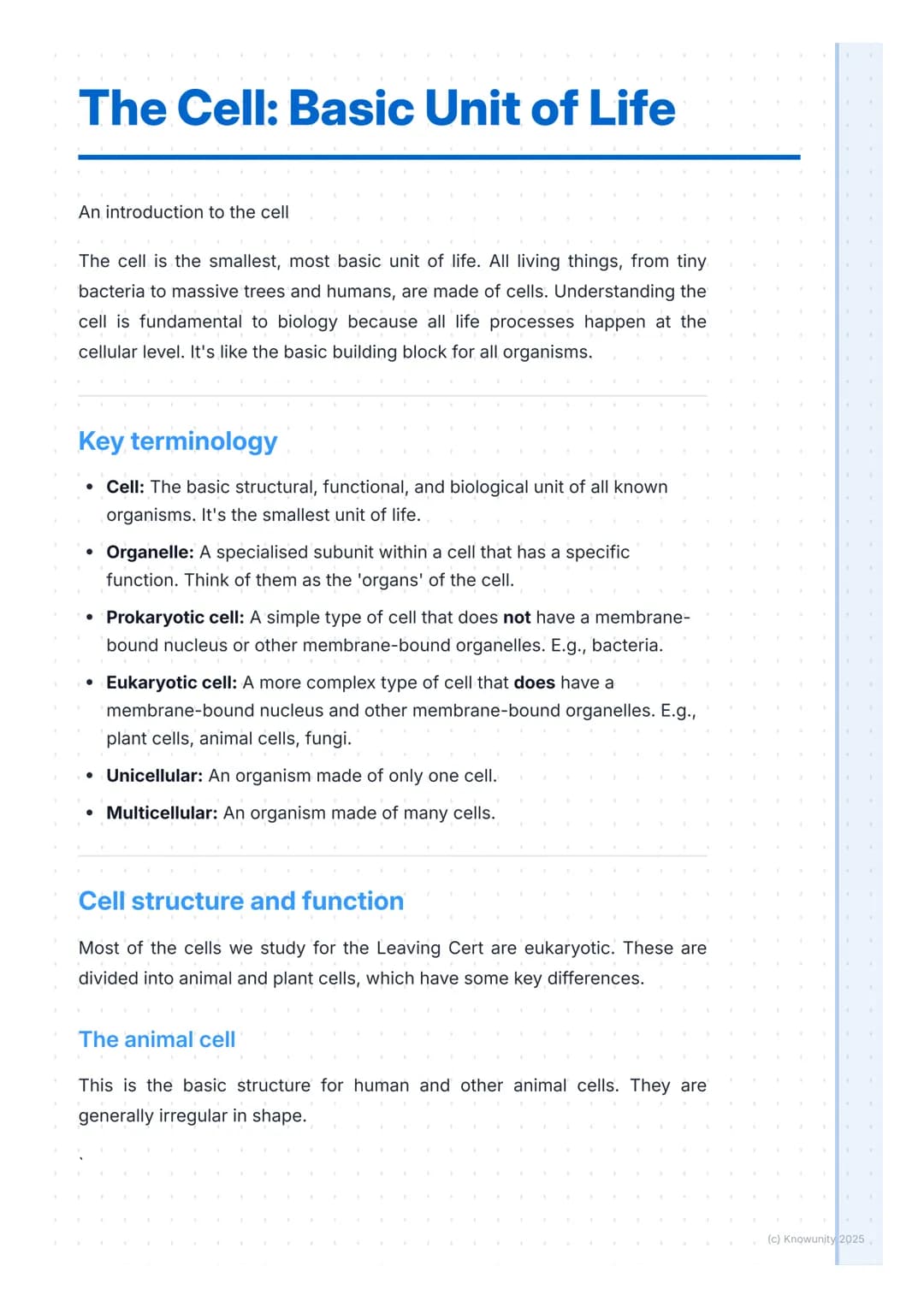
You're constantly surrounded by trillions of cells - they're literally everywhere, including the roughly 37 trillion that make up your own body! Cells are the fundamental building blocks of all living organisms, and every single life process happens at the cellular level.
There are two main types of cells you need to know. Prokaryotic cells are the simple ones - think bacteria - that don't have a proper nucleus or organised compartments. Eukaryotic cells are the complex ones that make up plants, animals, and fungi, complete with a nucleus and specialised compartments called organelles.
Living things can be unicellular (made of just one cell, like bacteria) or multicellular (made of many cells working together, like you). For your Leaving Cert, you'll mainly focus on eukaryotic cells, particularly plant and animal cells.
Remember: Organelles are like the "organs" of a cell - each one has a specific job to keep the cell functioning properly.
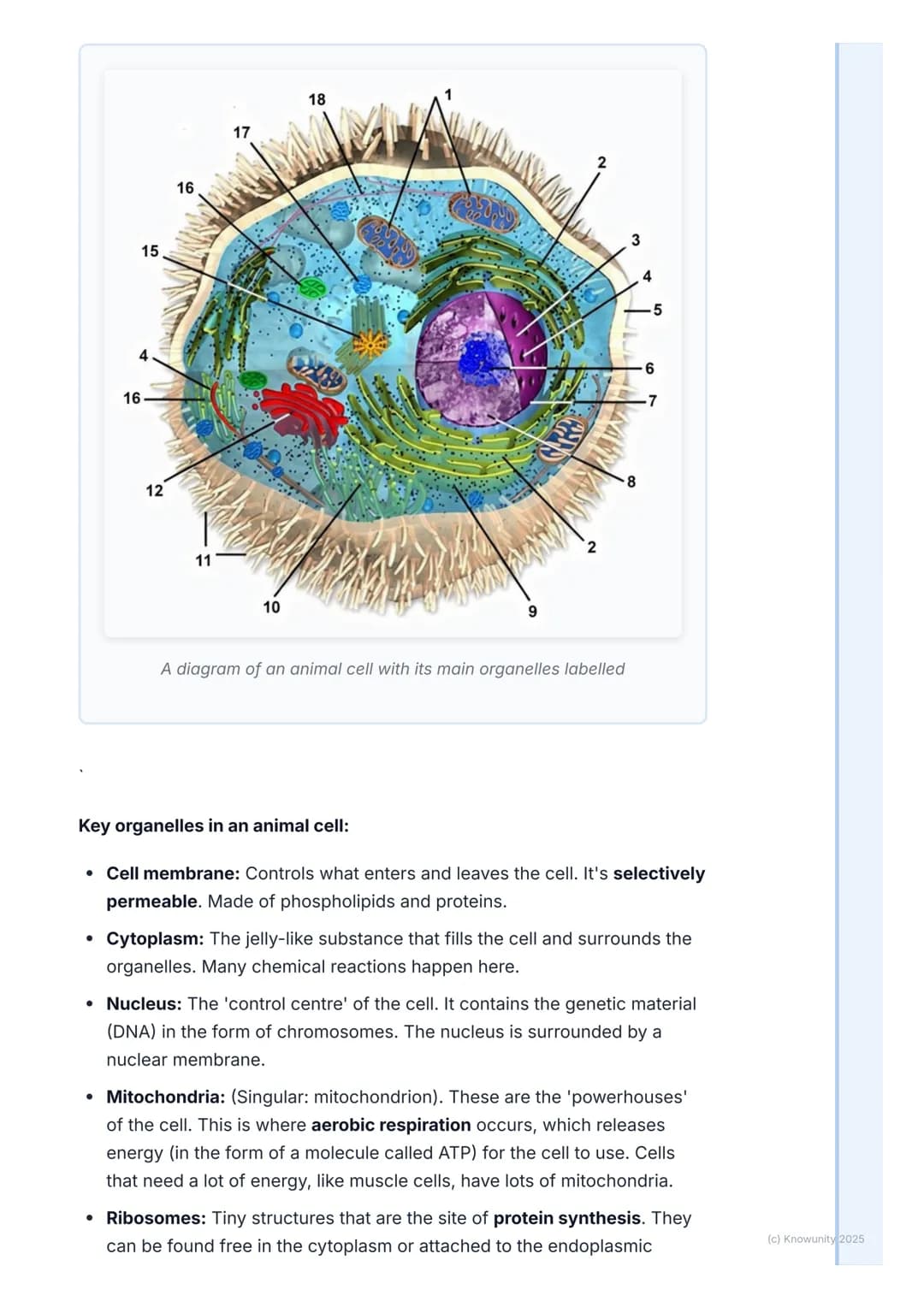
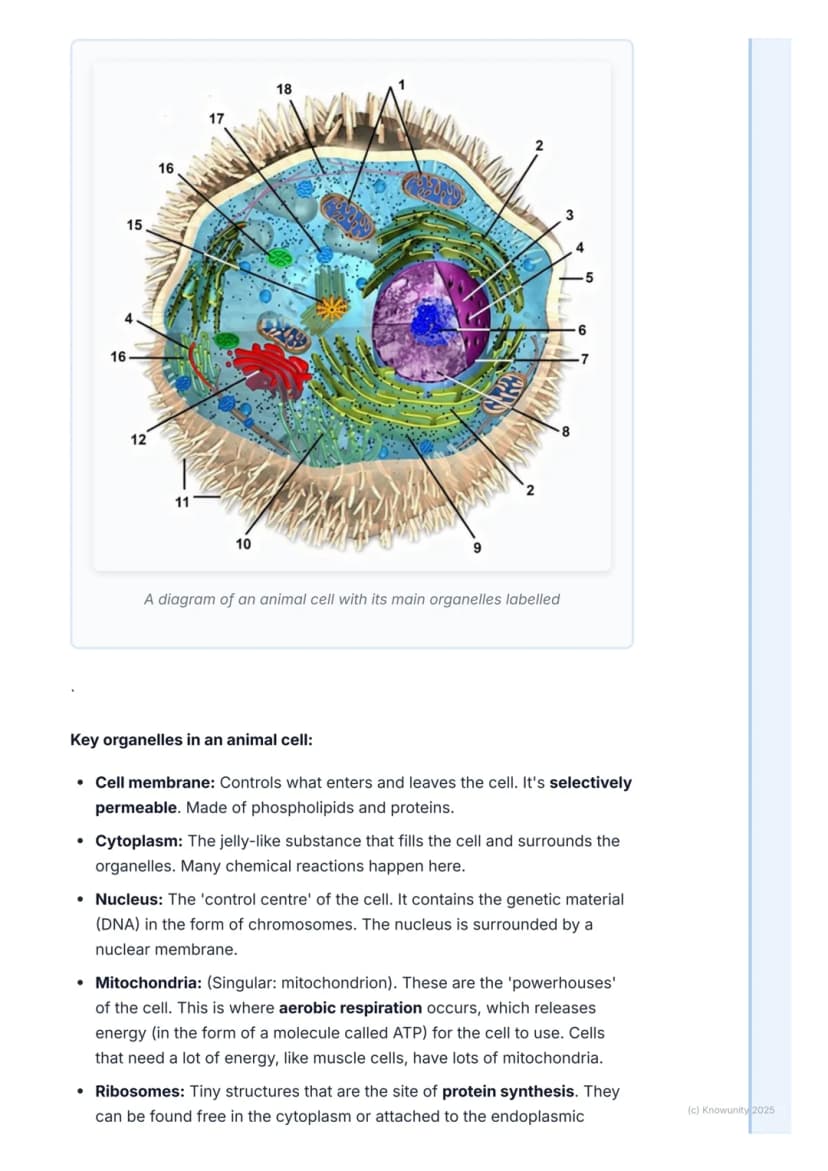
Animal cells are your basic cellular template - they're usually round or irregular in shape and packed with amazing tiny machines. The cell membrane acts like a bouncer at a club, deciding what gets in and out of the cell using its selective permeability.
Inside, the cytoplasm is like a jelly-filled workspace where loads of chemical reactions happen. The nucleus is absolutely crucial - it's the control centre containing all your genetic material (DNA) wrapped up in chromosomes, surrounded by its own protective membrane.
Mitochondria are the real heroes here - they're often called the "powerhouses" because they carry out respiration to release energy as ATP. Muscle cells are packed with these because they need loads of energy! Ribosomes are tiny protein-making factories that can float freely or attach to the endoplasmic reticulum.
Top Tip: Cells that need more energy (like heart muscle cells) contain way more mitochondria - this shows how structure relates to function!
The endoplasmic reticulum (ER) is like the cell's internal highway system for transporting materials. There are two types: rough ER (covered in ribosomes, looks bumpy) handles proteins, whilst smooth ER (no ribosomes) deals with lipids and other substances.
Vesicles are like tiny delivery vans - small membrane-bound sacs that transport substances around the cell. They're constantly moving materials from one place to another, keeping everything organised.
These organelles work together like a well-oiled machine. When you understand how each part contributes to the whole system, cell biology starts making perfect sense!
Exam Smart: Remember that animal cells can have small, temporary vacuoles, but they're nothing like the massive ones in plant cells.
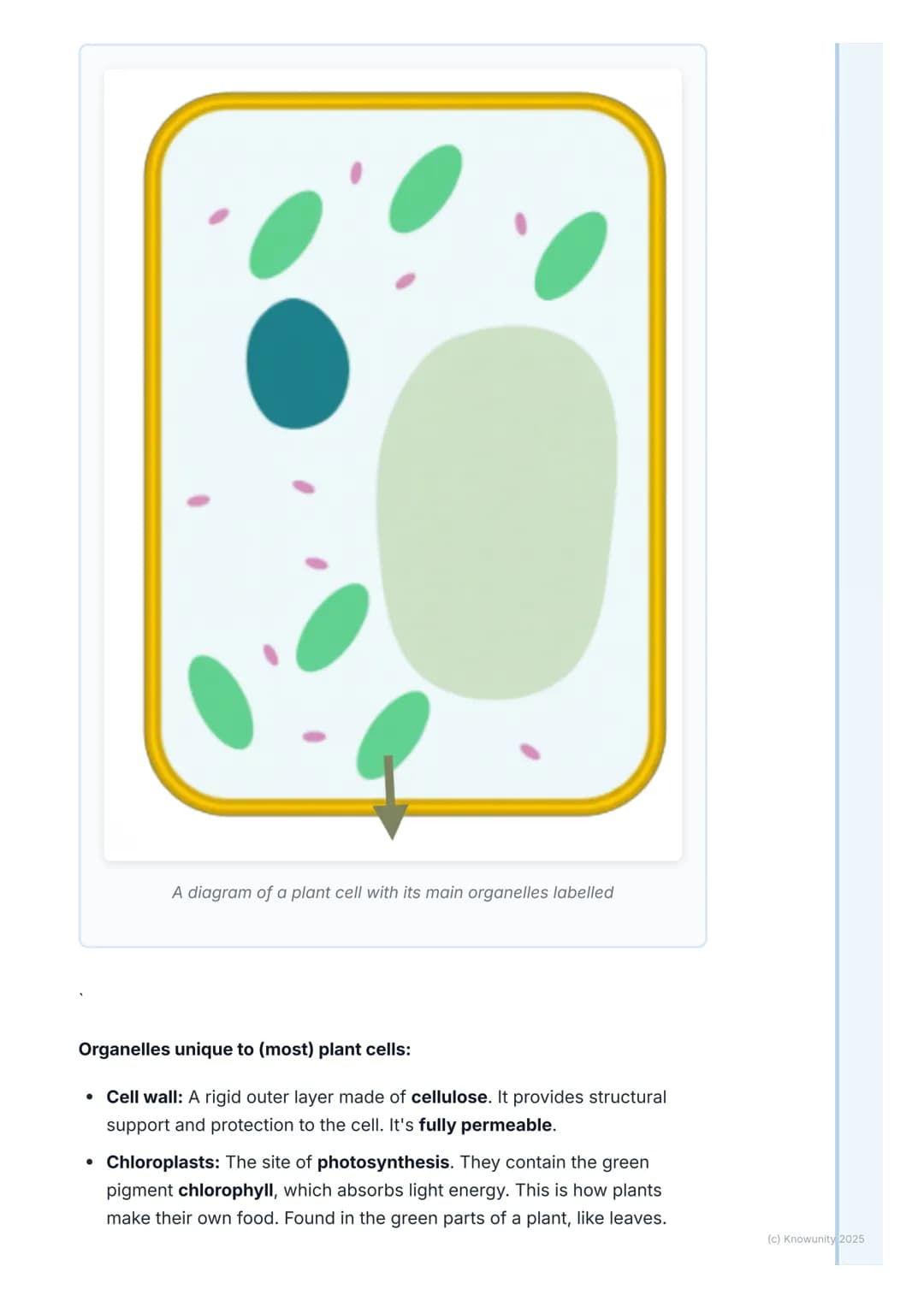
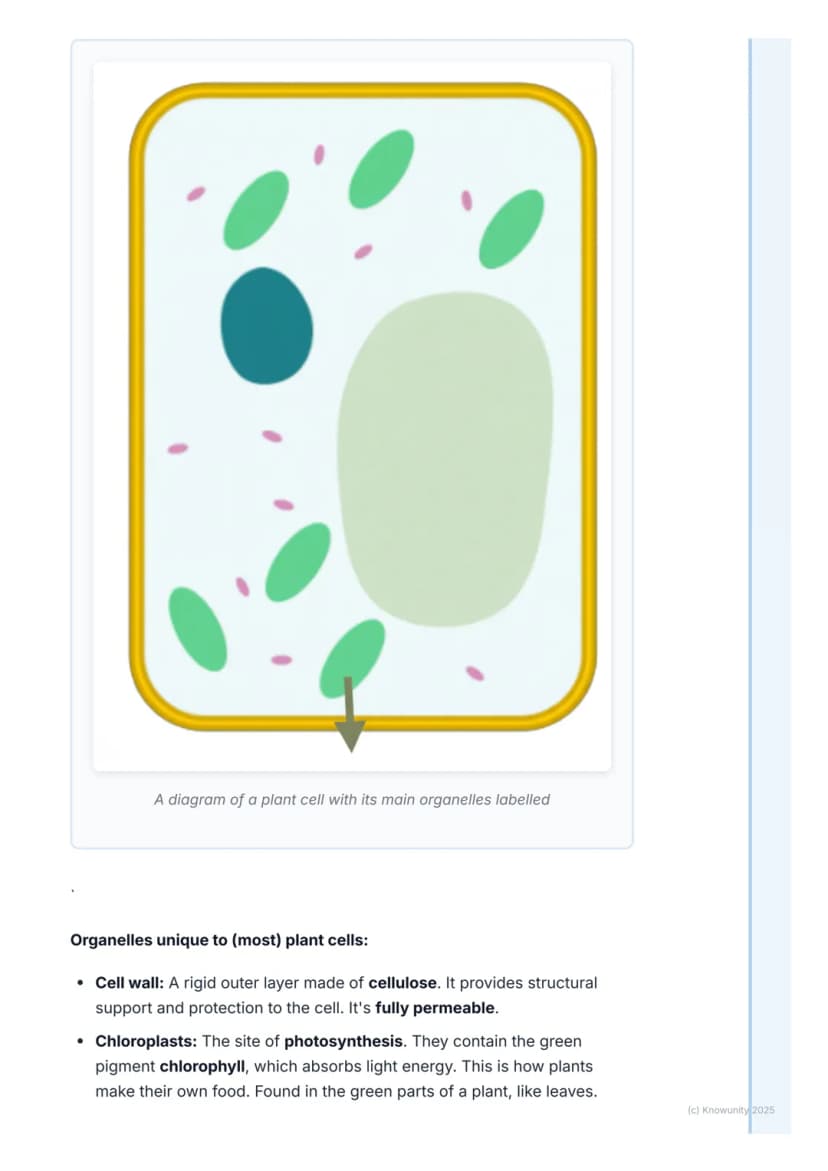
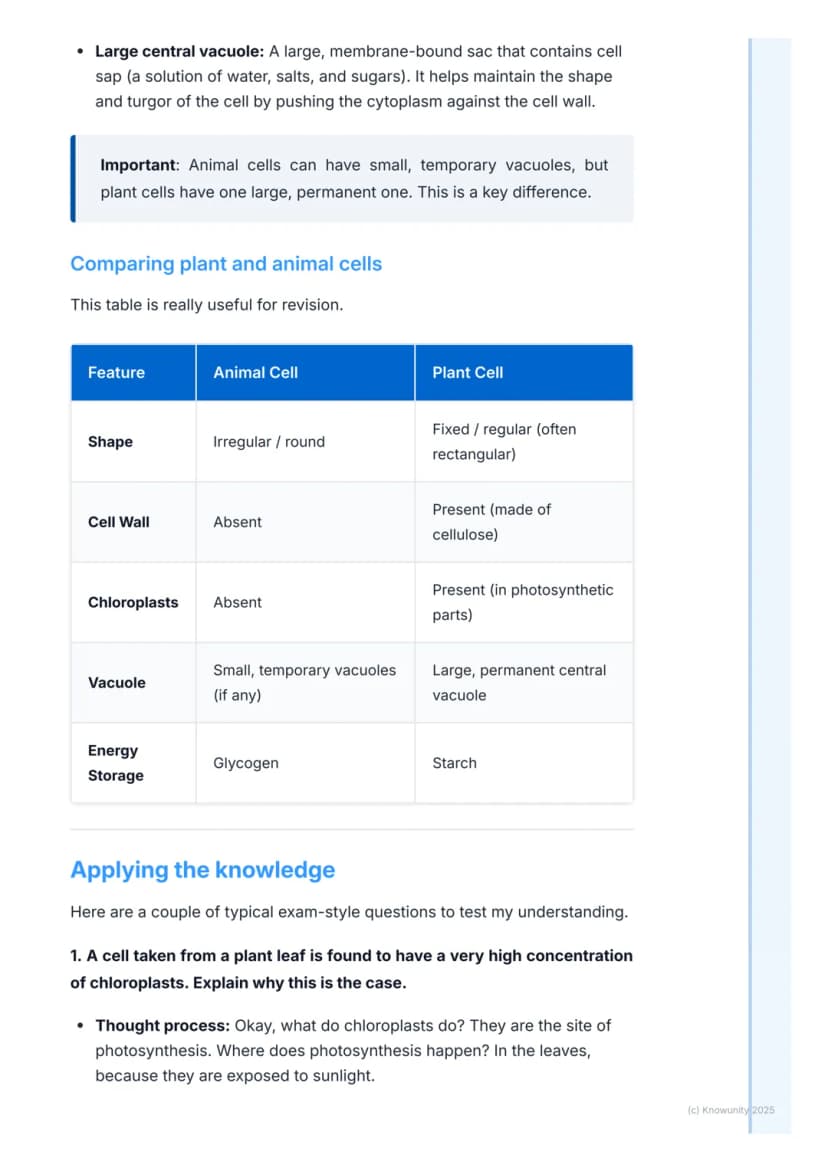
Plant cells are like upgraded animal cells with some brilliant extras that help them make their own food and stand upright. They typically have a more fixed, rectangular shape thanks to their rigid cell wall made of cellulose.
The cell wall is the plant's suit of armour - it provides structural support and protection whilst being fully permeable (unlike the selective cell membrane). This is why plants can grow so tall without collapsing!
Chloroplasts are the green magic-makers containing chlorophyll, the pigment that captures sunlight for photosynthesis. You'll find loads of these in leaf cells because that's where most photosynthesis happens. They're basically the plant's solar panels!
Key Point: Plant cells have all the same organelles as animal cells PLUS the cell wall, chloroplasts, and a large central vacuole.
The large central vacuole is like a plant cell's storage tank and support system rolled into one. It's filled with cell sap (water, salts, and sugars) and helps maintain the cell's shape by pushing outwards against the cell wall - this is called turgor pressure.
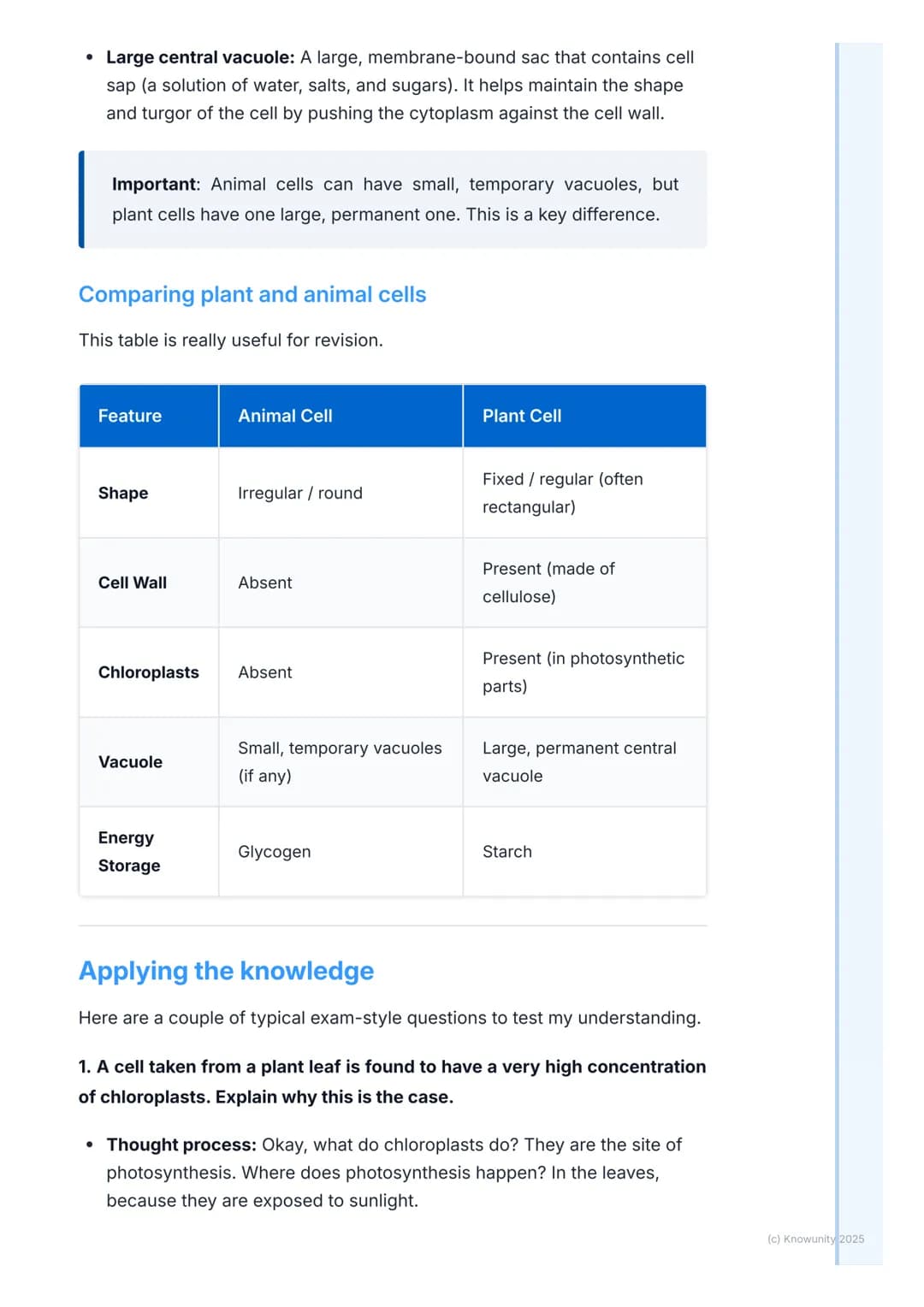
Here's a handy comparison: animal cells are irregular and flexible, whilst plant cells are fixed and rectangular. Animal cells store energy as glycogen, plants use starch. Most importantly, plants can photosynthesise thanks to their chloroplasts, whilst animals must get their energy by eating other organisms.
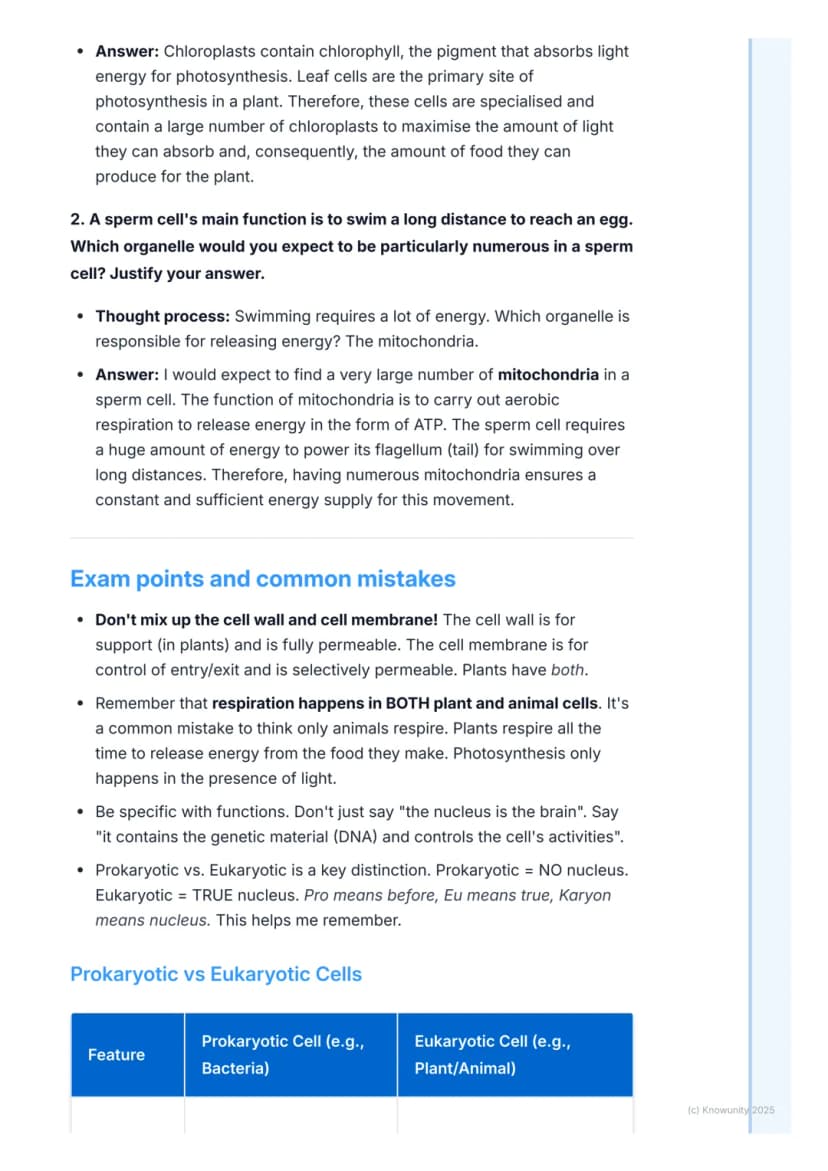
When tackling exam questions, think about structure matching function. Leaf cells packed with chloroplasts? Perfect for photosynthesis. Sperm cells loaded with mitochondria? Ideal for that energy-demanding swim to reach an egg!
Exam Tip: Don't confuse the cell wall (structural support, fully permeable) with the cell membrane - plants have both!
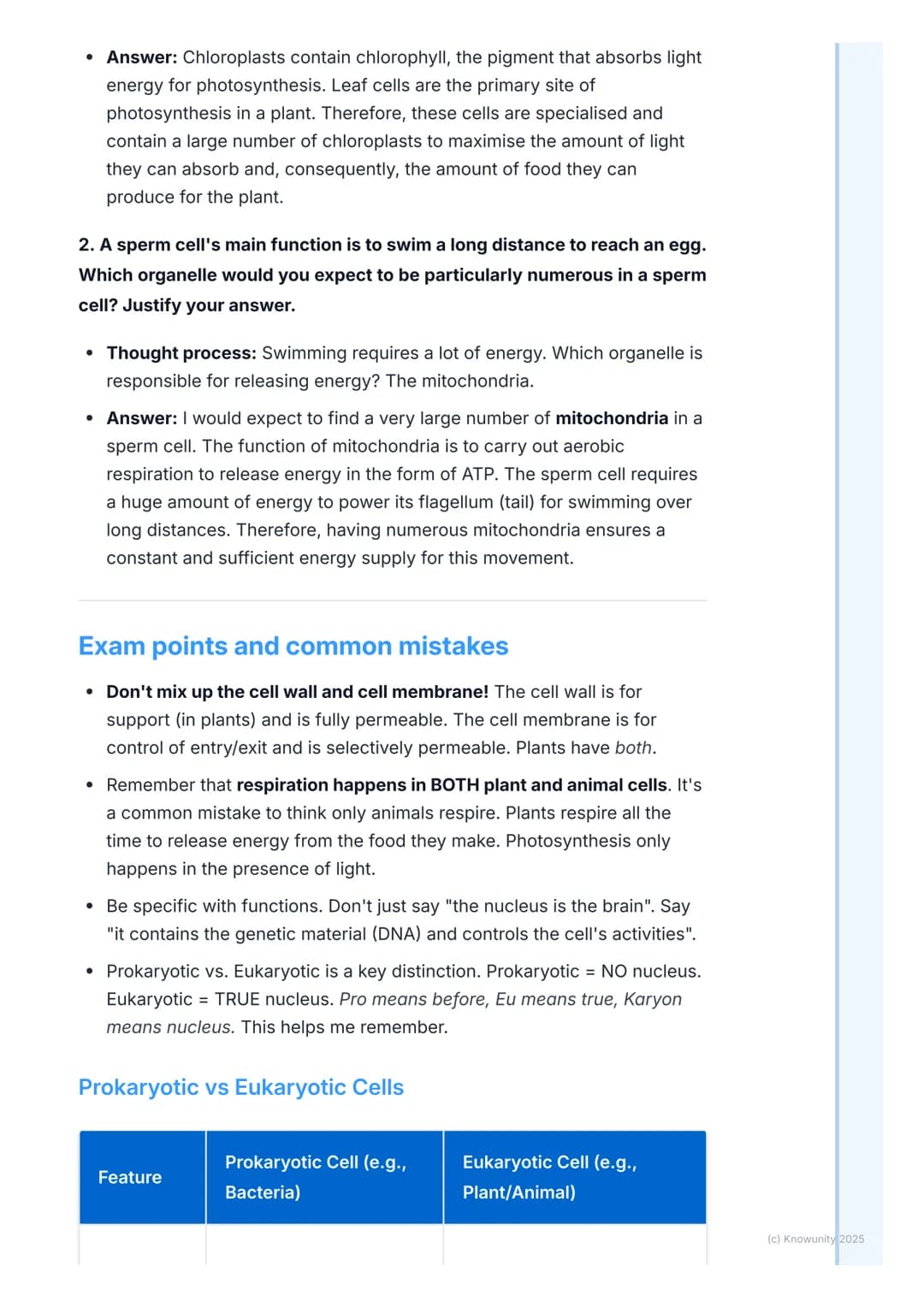
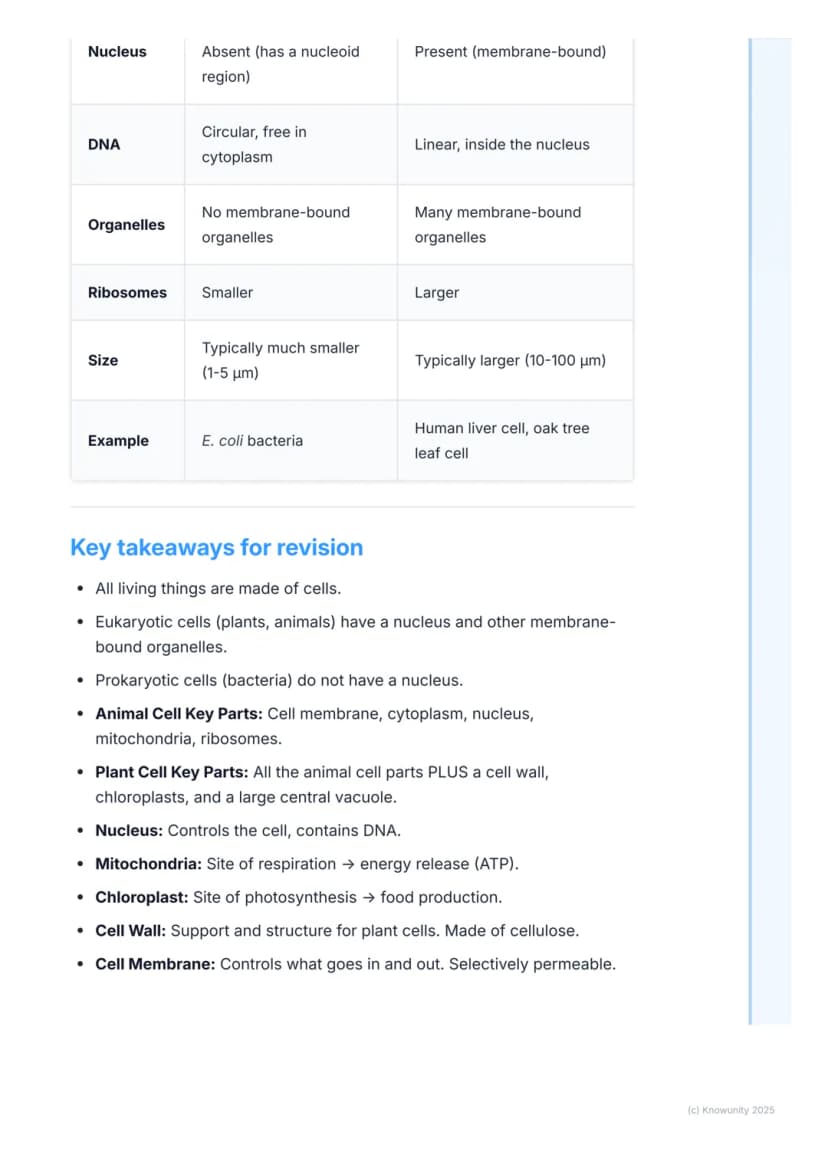
Understanding the difference between prokaryotic and eukaryotic cells is absolutely essential for your exams. Prokaryotic cells (like bacteria) are the minimalists of the cell world - no nucleus, no membrane-bound organelles, just DNA floating freely in a region called the nucleoid.
Eukaryotic cells are the complete opposite - they've got a proper nucleus with DNA neatly packaged inside, plus loads of specialised organelles doing different jobs. They're also much larger than prokaryotic cells .
Remember the word origins: "pro" means before, "eu" means true, and "karyon" means nucleus. So prokaryotic = "before nucleus" (evolved first, no proper nucleus) and eukaryotic = "true nucleus" (evolved later, has a proper nucleus).
Memory Trick: Think of prokaryotic cells as studio apartments (everything in one space) and eukaryotic cells as mansions (lots of separate rooms with specific purposes).
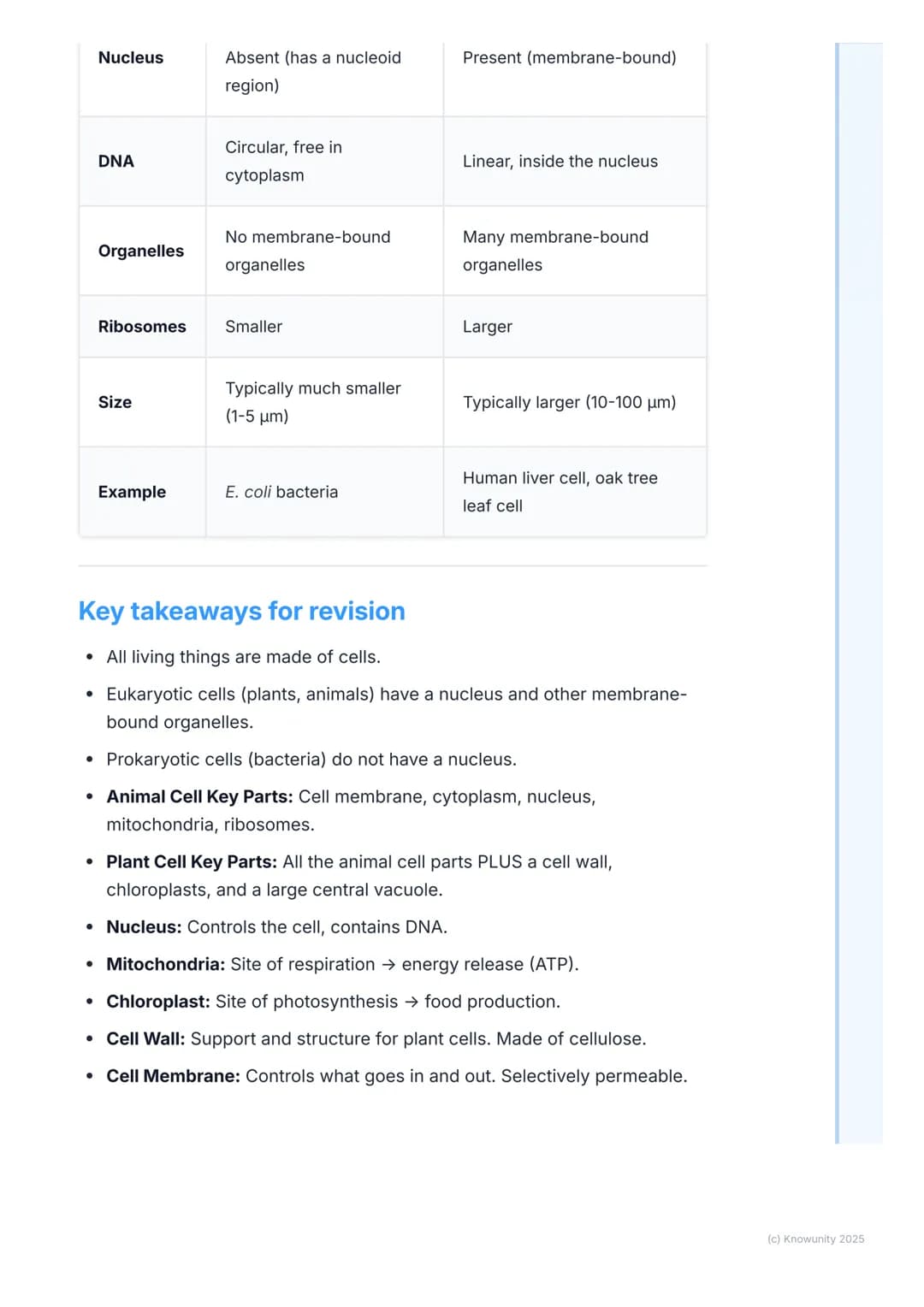
Here's what you absolutely must remember: all living things are made of cells, and there are two main types - prokaryotic (bacteria) and eukaryotic (plants, animals, fungi). Animal cells have the basic kit: cell membrane, cytoplasm, nucleus, mitochondria, and ribosomes.
Plant cells have everything animal cells have, plus three crucial extras: a cell wall for support, chloroplasts for photosynthesis, and a large central vacuole for storage and structure. Each organelle has a specific job that matches its structure perfectly.
Common exam mistakes to avoid: don't mix up cell walls and cell membranes, remember that plants DO respire (they need energy too!), and always be specific about functions rather than using vague terms like "the nucleus is the brain."
Final Tip: When answering exam questions, always explain WHY a cell has certain organelles by linking structure to function - this shows real understanding!
Nuestro compañero de IA está específicamente adaptado a las necesidades de los estudiantes. Basándonos en los millones de contenidos que tenemos en la plataforma, podemos dar a los estudiantes respuestas realmente significativas y relevantes. Pero no se trata solo de respuestas, el compañero también guía a los estudiantes a través de sus retos de aprendizaje diarios, con planes de aprendizaje personalizados, cuestionarios o contenidos en el chat y una personalización del 100% basada en las habilidades y el desarrollo de los estudiantes.
Puedes descargar la app en Google Play Store y Apple App Store.
¡Sí lo es! Tienes acceso totalmente gratuito a todo el contenido de la app, puedes chatear con otros alumnos y recibir ayuda inmeditamente. Puedes ganar dinero utilizando la aplicación, que te permitirá acceder a determinadas funciones.
App Store
Google Play
La app es muy fácil de usar y está muy bien diseñada. Hasta ahora he encontrado todo lo que estaba buscando y he podido aprender mucho de las presentaciones. Definitivamente utilizaré la aplicación para un examen de clase. Y, por supuesto, también me sirve mucho de inspiración.
Pablo
usuario de iOS
Esta app es realmente genial. Hay tantos apuntes de clase y ayuda [...]. Tengo problemas con matemáticas, por ejemplo, y la aplicación tiene muchas opciones de ayuda. Gracias a Knowunity, he mejorado en mates. Se la recomiendo a todo el mundo.
Elena
usuaria de Android
Vaya, estoy realmente sorprendida. Acabo de probar la app porque la he visto anunciada muchas veces y me he quedado absolutamente alucinada. Esta app es LA AYUDA que quieres para el insti y, sobre todo, ofrece muchísimas cosas, como ejercicios y hojas informativas, que a mí personalmente me han sido MUY útiles.
Ana
usuaria de iOS
Una increíble aplicación, de verdad. Apareció en el momento en que necesitaba una app que me ayude a organizar mis estudios, al igual que para prepararme para los exámenes. Te da una increíble variedad de estudio que simplemente me encanta. Además de ser una gran ayuda para estudiantes de diferentes grados, como la universidad, lo que más me gusta de esta app es que está para diferentes países.
Bárbara
Chile
Me encantó. La app es superior, buena para los estudiantes. No solo te da las respuestas, sino que también te las explica de una manera asombrosa, lo que hace que entiendas súper rápido. La recomiendo mucho si se te hace difícil comprender las materias que te dejan.
Jennifer
Perú
Muy buena aplicación, da información precisa de lo que se le pide. Es eficiente y, sobre todo, tiene varios intereses a escoger, como por ejemplo, temas sobre el ICFES, temas de bachillerato, entre otros. Excelente app.
Lady
Colombia
¡La app es buenísima! Sólo tengo que introducir el tema en la barra de búsqueda y recibo la respuesta muy rápido. No tengo que ver 10 vídeos de YouTube para entender algo, así que me ahorro tiempo. ¡Muy recomendable!
Sara
usuaria de Android
En el instituto era muy malo en matemáticas, pero gracias a la app, ahora saco mejores notas. Os agradezco mucho que hayáis creado la aplicación.
Roberto
usuario de Android
Me costaba demasiado estudiar porque no entiendo cuando me pongo a estudiar, y en los exámenes me iba mal, hasta que me empezaron a aparecer anuncios y la descargué sin tenerle fe. Gracias a esta aplicación, algo que no entendía hace meses y semanas lo entendí. En esta aplicación mis notas mejoraron, y ya no me tengo que preocupar por estudiar.
Antonella
Argentina
¡Excelente! Amé la app. Me parece súper eficiente. Aparte de que enseña mucho, te ayuda en tus problemas personales y te hace resúmenes. Amo. Amé un montón la app. Sirve para cualquier año, desde sexto hasta quinto año. Aparte, hay resúmenes de otras personas. ¡Nonono, loquísimo! Te la recomiendo al 100%. Efectivamente, es un 10/10.
Usuario argentino
iOS.
Excelente experiencia. La aplicación es buenísima, la recomiendo mucho. Es mucho mejor que ChatGPT. Te manda la respuesta de tus búsquedas y, aparte, diapositivas para estudiar. Es magnífica.
Alo
México
¡ME ENCANTA! Todo es muy sencillo de utilizar y aprender. Mi IA es muy buena y los apuntes de los demás estudiantes son súper buenos; explica las cosas súper bien y detalladamente. La amo. Pruébenla.
Kitty
Colombia
La app es muy fácil de usar y está muy bien diseñada. Hasta ahora he encontrado todo lo que estaba buscando y he podido aprender mucho de las presentaciones. Definitivamente utilizaré la aplicación para un examen de clase. Y, por supuesto, también me sirve mucho de inspiración.
Pablo
usuario de iOS
Esta app es realmente genial. Hay tantos apuntes de clase y ayuda [...]. Tengo problemas con matemáticas, por ejemplo, y la aplicación tiene muchas opciones de ayuda. Gracias a Knowunity, he mejorado en mates. Se la recomiendo a todo el mundo.
Elena
usuaria de Android
Vaya, estoy realmente sorprendida. Acabo de probar la app porque la he visto anunciada muchas veces y me he quedado absolutamente alucinada. Esta app es LA AYUDA que quieres para el insti y, sobre todo, ofrece muchísimas cosas, como ejercicios y hojas informativas, que a mí personalmente me han sido MUY útiles.
Ana
usuaria de iOS
Una increíble aplicación, de verdad. Apareció en el momento en que necesitaba una app que me ayude a organizar mis estudios, al igual que para prepararme para los exámenes. Te da una increíble variedad de estudio que simplemente me encanta. Además de ser una gran ayuda para estudiantes de diferentes grados, como la universidad, lo que más me gusta de esta app es que está para diferentes países.
Bárbara
Chile
Me encantó. La app es superior, buena para los estudiantes. No solo te da las respuestas, sino que también te las explica de una manera asombrosa, lo que hace que entiendas súper rápido. La recomiendo mucho si se te hace difícil comprender las materias que te dejan.
Jennifer
Perú
Muy buena aplicación, da información precisa de lo que se le pide. Es eficiente y, sobre todo, tiene varios intereses a escoger, como por ejemplo, temas sobre el ICFES, temas de bachillerato, entre otros. Excelente app.
Lady
Colombia
¡La app es buenísima! Sólo tengo que introducir el tema en la barra de búsqueda y recibo la respuesta muy rápido. No tengo que ver 10 vídeos de YouTube para entender algo, así que me ahorro tiempo. ¡Muy recomendable!
Sara
usuaria de Android
En el instituto era muy malo en matemáticas, pero gracias a la app, ahora saco mejores notas. Os agradezco mucho que hayáis creado la aplicación.
Roberto
usuario de Android
Me costaba demasiado estudiar porque no entiendo cuando me pongo a estudiar, y en los exámenes me iba mal, hasta que me empezaron a aparecer anuncios y la descargué sin tenerle fe. Gracias a esta aplicación, algo que no entendía hace meses y semanas lo entendí. En esta aplicación mis notas mejoraron, y ya no me tengo que preocupar por estudiar.
Antonella
Argentina
¡Excelente! Amé la app. Me parece súper eficiente. Aparte de que enseña mucho, te ayuda en tus problemas personales y te hace resúmenes. Amo. Amé un montón la app. Sirve para cualquier año, desde sexto hasta quinto año. Aparte, hay resúmenes de otras personas. ¡Nonono, loquísimo! Te la recomiendo al 100%. Efectivamente, es un 10/10.
Usuario argentino
iOS.
Excelente experiencia. La aplicación es buenísima, la recomiendo mucho. Es mucho mejor que ChatGPT. Te manda la respuesta de tus búsquedas y, aparte, diapositivas para estudiar. Es magnífica.
Alo
México
¡ME ENCANTA! Todo es muy sencillo de utilizar y aprender. Mi IA es muy buena y los apuntes de los demás estudiantes son súper buenos; explica las cosas súper bien y detalladamente. La amo. Pruébenla.
Kitty
Colombia
Every living thing on Earth is made up of cells - from the tiniest bacteria to massive whales and towering oak trees. Think of cells as the LEGO blocks of life: they're the smallest units that can actually be called... Mostrar más
Acceso a todos los documentos
Mejora tus notas
Únete a millones de estudiantes
You're constantly surrounded by trillions of cells - they're literally everywhere, including the roughly 37 trillion that make up your own body! Cells are the fundamental building blocks of all living organisms, and every single life process happens at the cellular level.
There are two main types of cells you need to know. Prokaryotic cells are the simple ones - think bacteria - that don't have a proper nucleus or organised compartments. Eukaryotic cells are the complex ones that make up plants, animals, and fungi, complete with a nucleus and specialised compartments called organelles.
Living things can be unicellular (made of just one cell, like bacteria) or multicellular (made of many cells working together, like you). For your Leaving Cert, you'll mainly focus on eukaryotic cells, particularly plant and animal cells.
Remember: Organelles are like the "organs" of a cell - each one has a specific job to keep the cell functioning properly.
Acceso a todos los documentos
Mejora tus notas
Únete a millones de estudiantes
Animal cells are your basic cellular template - they're usually round or irregular in shape and packed with amazing tiny machines. The cell membrane acts like a bouncer at a club, deciding what gets in and out of the cell using its selective permeability.
Inside, the cytoplasm is like a jelly-filled workspace where loads of chemical reactions happen. The nucleus is absolutely crucial - it's the control centre containing all your genetic material (DNA) wrapped up in chromosomes, surrounded by its own protective membrane.
Mitochondria are the real heroes here - they're often called the "powerhouses" because they carry out respiration to release energy as ATP. Muscle cells are packed with these because they need loads of energy! Ribosomes are tiny protein-making factories that can float freely or attach to the endoplasmic reticulum.
Top Tip: Cells that need more energy (like heart muscle cells) contain way more mitochondria - this shows how structure relates to function!
Acceso a todos los documentos
Mejora tus notas
Únete a millones de estudiantes
The endoplasmic reticulum (ER) is like the cell's internal highway system for transporting materials. There are two types: rough ER (covered in ribosomes, looks bumpy) handles proteins, whilst smooth ER (no ribosomes) deals with lipids and other substances.
Vesicles are like tiny delivery vans - small membrane-bound sacs that transport substances around the cell. They're constantly moving materials from one place to another, keeping everything organised.
These organelles work together like a well-oiled machine. When you understand how each part contributes to the whole system, cell biology starts making perfect sense!
Exam Smart: Remember that animal cells can have small, temporary vacuoles, but they're nothing like the massive ones in plant cells.
Acceso a todos los documentos
Mejora tus notas
Únete a millones de estudiantes
Plant cells are like upgraded animal cells with some brilliant extras that help them make their own food and stand upright. They typically have a more fixed, rectangular shape thanks to their rigid cell wall made of cellulose.
The cell wall is the plant's suit of armour - it provides structural support and protection whilst being fully permeable (unlike the selective cell membrane). This is why plants can grow so tall without collapsing!
Chloroplasts are the green magic-makers containing chlorophyll, the pigment that captures sunlight for photosynthesis. You'll find loads of these in leaf cells because that's where most photosynthesis happens. They're basically the plant's solar panels!
Key Point: Plant cells have all the same organelles as animal cells PLUS the cell wall, chloroplasts, and a large central vacuole.
Acceso a todos los documentos
Mejora tus notas
Únete a millones de estudiantes
The large central vacuole is like a plant cell's storage tank and support system rolled into one. It's filled with cell sap (water, salts, and sugars) and helps maintain the cell's shape by pushing outwards against the cell wall - this is called turgor pressure.
Here's a handy comparison: animal cells are irregular and flexible, whilst plant cells are fixed and rectangular. Animal cells store energy as glycogen, plants use starch. Most importantly, plants can photosynthesise thanks to their chloroplasts, whilst animals must get their energy by eating other organisms.
When tackling exam questions, think about structure matching function. Leaf cells packed with chloroplasts? Perfect for photosynthesis. Sperm cells loaded with mitochondria? Ideal for that energy-demanding swim to reach an egg!
Exam Tip: Don't confuse the cell wall (structural support, fully permeable) with the cell membrane - plants have both!
Acceso a todos los documentos
Mejora tus notas
Únete a millones de estudiantes
Understanding the difference between prokaryotic and eukaryotic cells is absolutely essential for your exams. Prokaryotic cells (like bacteria) are the minimalists of the cell world - no nucleus, no membrane-bound organelles, just DNA floating freely in a region called the nucleoid.
Eukaryotic cells are the complete opposite - they've got a proper nucleus with DNA neatly packaged inside, plus loads of specialised organelles doing different jobs. They're also much larger than prokaryotic cells .
Remember the word origins: "pro" means before, "eu" means true, and "karyon" means nucleus. So prokaryotic = "before nucleus" (evolved first, no proper nucleus) and eukaryotic = "true nucleus" (evolved later, has a proper nucleus).
Memory Trick: Think of prokaryotic cells as studio apartments (everything in one space) and eukaryotic cells as mansions (lots of separate rooms with specific purposes).
Acceso a todos los documentos
Mejora tus notas
Únete a millones de estudiantes
Here's what you absolutely must remember: all living things are made of cells, and there are two main types - prokaryotic (bacteria) and eukaryotic (plants, animals, fungi). Animal cells have the basic kit: cell membrane, cytoplasm, nucleus, mitochondria, and ribosomes.
Plant cells have everything animal cells have, plus three crucial extras: a cell wall for support, chloroplasts for photosynthesis, and a large central vacuole for storage and structure. Each organelle has a specific job that matches its structure perfectly.
Common exam mistakes to avoid: don't mix up cell walls and cell membranes, remember that plants DO respire (they need energy too!), and always be specific about functions rather than using vague terms like "the nucleus is the brain."
Final Tip: When answering exam questions, always explain WHY a cell has certain organelles by linking structure to function - this shows real understanding!
Nuestro compañero de IA está específicamente adaptado a las necesidades de los estudiantes. Basándonos en los millones de contenidos que tenemos en la plataforma, podemos dar a los estudiantes respuestas realmente significativas y relevantes. Pero no se trata solo de respuestas, el compañero también guía a los estudiantes a través de sus retos de aprendizaje diarios, con planes de aprendizaje personalizados, cuestionarios o contenidos en el chat y una personalización del 100% basada en las habilidades y el desarrollo de los estudiantes.
Puedes descargar la app en Google Play Store y Apple App Store.
¡Sí lo es! Tienes acceso totalmente gratuito a todo el contenido de la app, puedes chatear con otros alumnos y recibir ayuda inmeditamente. Puedes ganar dinero utilizando la aplicación, que te permitirá acceder a determinadas funciones.
0
Herramientas Inteligentes NUEVO
Transformá estos apuntes en: ✓ 50+ Preguntas de Práctica ✓ Fichas Interactivas ✓ Simulacro Completo de Examen ✓ Esquemas de Ensayo
App Store
Google Play
La app es muy fácil de usar y está muy bien diseñada. Hasta ahora he encontrado todo lo que estaba buscando y he podido aprender mucho de las presentaciones. Definitivamente utilizaré la aplicación para un examen de clase. Y, por supuesto, también me sirve mucho de inspiración.
Pablo
usuario de iOS
Esta app es realmente genial. Hay tantos apuntes de clase y ayuda [...]. Tengo problemas con matemáticas, por ejemplo, y la aplicación tiene muchas opciones de ayuda. Gracias a Knowunity, he mejorado en mates. Se la recomiendo a todo el mundo.
Elena
usuaria de Android
Vaya, estoy realmente sorprendida. Acabo de probar la app porque la he visto anunciada muchas veces y me he quedado absolutamente alucinada. Esta app es LA AYUDA que quieres para el insti y, sobre todo, ofrece muchísimas cosas, como ejercicios y hojas informativas, que a mí personalmente me han sido MUY útiles.
Ana
usuaria de iOS
Una increíble aplicación, de verdad. Apareció en el momento en que necesitaba una app que me ayude a organizar mis estudios, al igual que para prepararme para los exámenes. Te da una increíble variedad de estudio que simplemente me encanta. Además de ser una gran ayuda para estudiantes de diferentes grados, como la universidad, lo que más me gusta de esta app es que está para diferentes países.
Bárbara
Chile
Me encantó. La app es superior, buena para los estudiantes. No solo te da las respuestas, sino que también te las explica de una manera asombrosa, lo que hace que entiendas súper rápido. La recomiendo mucho si se te hace difícil comprender las materias que te dejan.
Jennifer
Perú
Muy buena aplicación, da información precisa de lo que se le pide. Es eficiente y, sobre todo, tiene varios intereses a escoger, como por ejemplo, temas sobre el ICFES, temas de bachillerato, entre otros. Excelente app.
Lady
Colombia
¡La app es buenísima! Sólo tengo que introducir el tema en la barra de búsqueda y recibo la respuesta muy rápido. No tengo que ver 10 vídeos de YouTube para entender algo, así que me ahorro tiempo. ¡Muy recomendable!
Sara
usuaria de Android
En el instituto era muy malo en matemáticas, pero gracias a la app, ahora saco mejores notas. Os agradezco mucho que hayáis creado la aplicación.
Roberto
usuario de Android
Me costaba demasiado estudiar porque no entiendo cuando me pongo a estudiar, y en los exámenes me iba mal, hasta que me empezaron a aparecer anuncios y la descargué sin tenerle fe. Gracias a esta aplicación, algo que no entendía hace meses y semanas lo entendí. En esta aplicación mis notas mejoraron, y ya no me tengo que preocupar por estudiar.
Antonella
Argentina
¡Excelente! Amé la app. Me parece súper eficiente. Aparte de que enseña mucho, te ayuda en tus problemas personales y te hace resúmenes. Amo. Amé un montón la app. Sirve para cualquier año, desde sexto hasta quinto año. Aparte, hay resúmenes de otras personas. ¡Nonono, loquísimo! Te la recomiendo al 100%. Efectivamente, es un 10/10.
Usuario argentino
iOS.
Excelente experiencia. La aplicación es buenísima, la recomiendo mucho. Es mucho mejor que ChatGPT. Te manda la respuesta de tus búsquedas y, aparte, diapositivas para estudiar. Es magnífica.
Alo
México
¡ME ENCANTA! Todo es muy sencillo de utilizar y aprender. Mi IA es muy buena y los apuntes de los demás estudiantes son súper buenos; explica las cosas súper bien y detalladamente. La amo. Pruébenla.
Kitty
Colombia
La app es muy fácil de usar y está muy bien diseñada. Hasta ahora he encontrado todo lo que estaba buscando y he podido aprender mucho de las presentaciones. Definitivamente utilizaré la aplicación para un examen de clase. Y, por supuesto, también me sirve mucho de inspiración.
Pablo
usuario de iOS
Esta app es realmente genial. Hay tantos apuntes de clase y ayuda [...]. Tengo problemas con matemáticas, por ejemplo, y la aplicación tiene muchas opciones de ayuda. Gracias a Knowunity, he mejorado en mates. Se la recomiendo a todo el mundo.
Elena
usuaria de Android
Vaya, estoy realmente sorprendida. Acabo de probar la app porque la he visto anunciada muchas veces y me he quedado absolutamente alucinada. Esta app es LA AYUDA que quieres para el insti y, sobre todo, ofrece muchísimas cosas, como ejercicios y hojas informativas, que a mí personalmente me han sido MUY útiles.
Ana
usuaria de iOS
Una increíble aplicación, de verdad. Apareció en el momento en que necesitaba una app que me ayude a organizar mis estudios, al igual que para prepararme para los exámenes. Te da una increíble variedad de estudio que simplemente me encanta. Además de ser una gran ayuda para estudiantes de diferentes grados, como la universidad, lo que más me gusta de esta app es que está para diferentes países.
Bárbara
Chile
Me encantó. La app es superior, buena para los estudiantes. No solo te da las respuestas, sino que también te las explica de una manera asombrosa, lo que hace que entiendas súper rápido. La recomiendo mucho si se te hace difícil comprender las materias que te dejan.
Jennifer
Perú
Muy buena aplicación, da información precisa de lo que se le pide. Es eficiente y, sobre todo, tiene varios intereses a escoger, como por ejemplo, temas sobre el ICFES, temas de bachillerato, entre otros. Excelente app.
Lady
Colombia
¡La app es buenísima! Sólo tengo que introducir el tema en la barra de búsqueda y recibo la respuesta muy rápido. No tengo que ver 10 vídeos de YouTube para entender algo, así que me ahorro tiempo. ¡Muy recomendable!
Sara
usuaria de Android
En el instituto era muy malo en matemáticas, pero gracias a la app, ahora saco mejores notas. Os agradezco mucho que hayáis creado la aplicación.
Roberto
usuario de Android
Me costaba demasiado estudiar porque no entiendo cuando me pongo a estudiar, y en los exámenes me iba mal, hasta que me empezaron a aparecer anuncios y la descargué sin tenerle fe. Gracias a esta aplicación, algo que no entendía hace meses y semanas lo entendí. En esta aplicación mis notas mejoraron, y ya no me tengo que preocupar por estudiar.
Antonella
Argentina
¡Excelente! Amé la app. Me parece súper eficiente. Aparte de que enseña mucho, te ayuda en tus problemas personales y te hace resúmenes. Amo. Amé un montón la app. Sirve para cualquier año, desde sexto hasta quinto año. Aparte, hay resúmenes de otras personas. ¡Nonono, loquísimo! Te la recomiendo al 100%. Efectivamente, es un 10/10.
Usuario argentino
iOS.
Excelente experiencia. La aplicación es buenísima, la recomiendo mucho. Es mucho mejor que ChatGPT. Te manda la respuesta de tus búsquedas y, aparte, diapositivas para estudiar. Es magnífica.
Alo
México
¡ME ENCANTA! Todo es muy sencillo de utilizar y aprender. Mi IA es muy buena y los apuntes de los demás estudiantes son súper buenos; explica las cosas súper bien y detalladamente. La amo. Pruébenla.
Kitty
Colombia