
Rational expressions are basically fractions with polynomials on top and... Mostrar más
 Mathematics5 visualizaciones·Actualizado May 31, 2026·6 páginas
Mastering Rational Expressions: Simplify, Solve, and Operate
1 / 6
1
of 6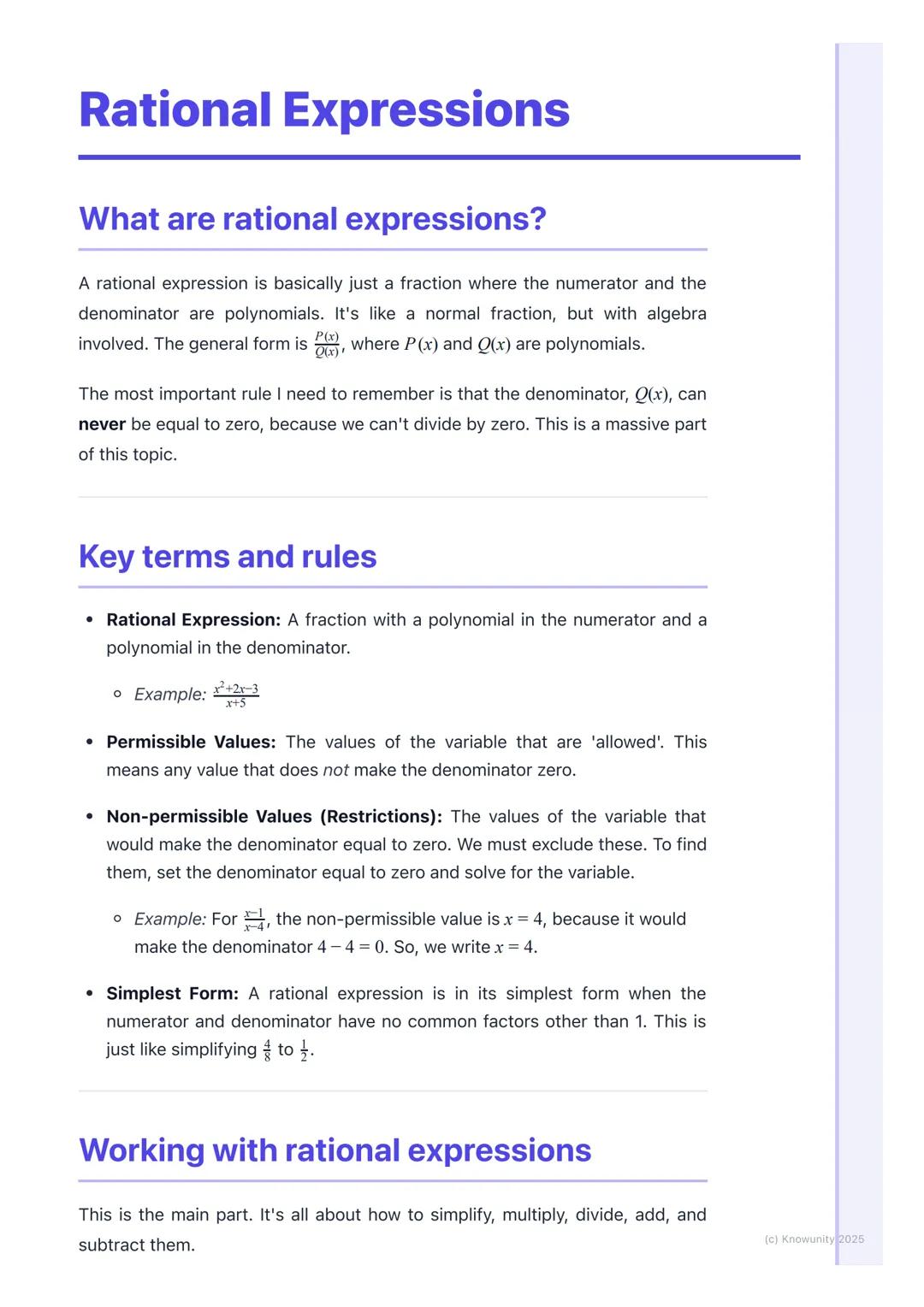
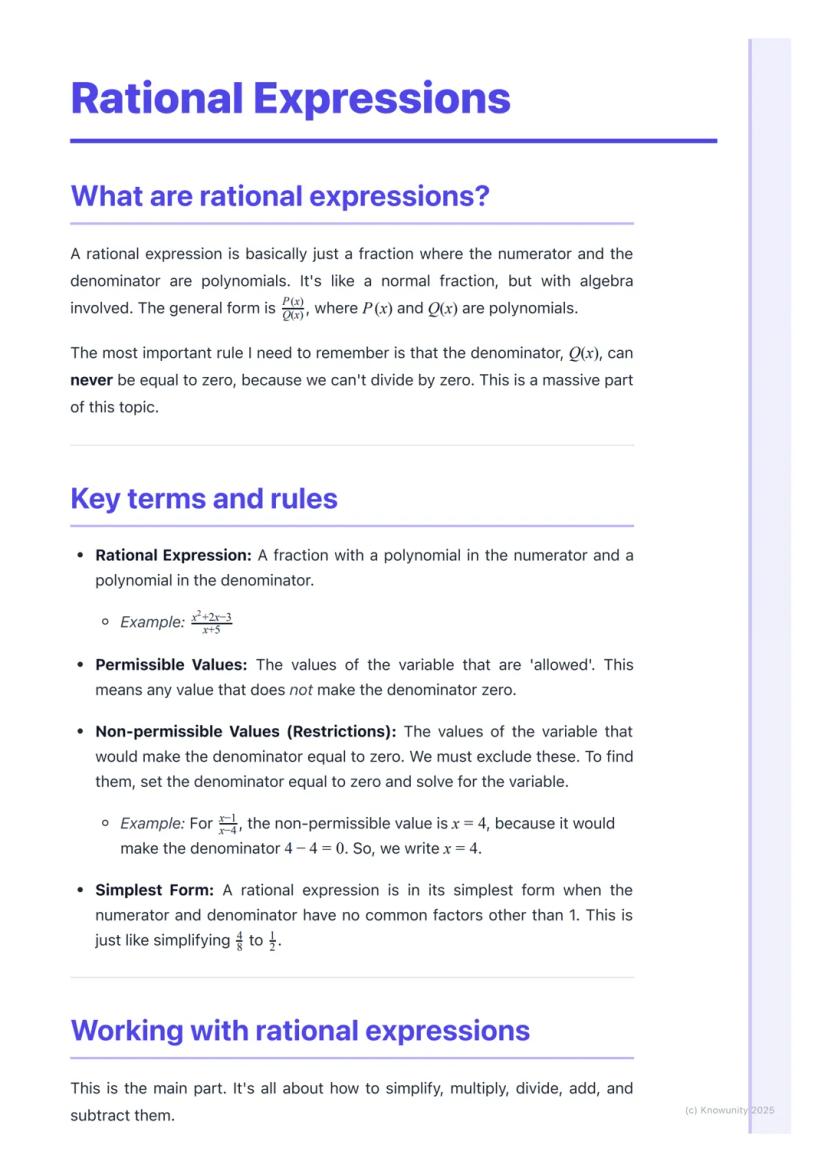
What Are Rational Expressions?
Ever wondered what happens when you mix fractions with algebra? You get rational expressions - fractions where both the numerator and denominator are polynomials, like .
The golden rule here is that the denominator can never equal zero because dividing by zero is mathematically impossible. This creates what we call restrictions or non-permissible values - basically the values of x that would make the denominator zero.
Finding restrictions is dead simple: set the denominator equal to zero and solve. For example, with , the restriction is x = 4 because that makes the bottom 4-4 = 0.
Pro tip: Always find your restrictions first - they'll be crucial when solving equations later on!
2
of 6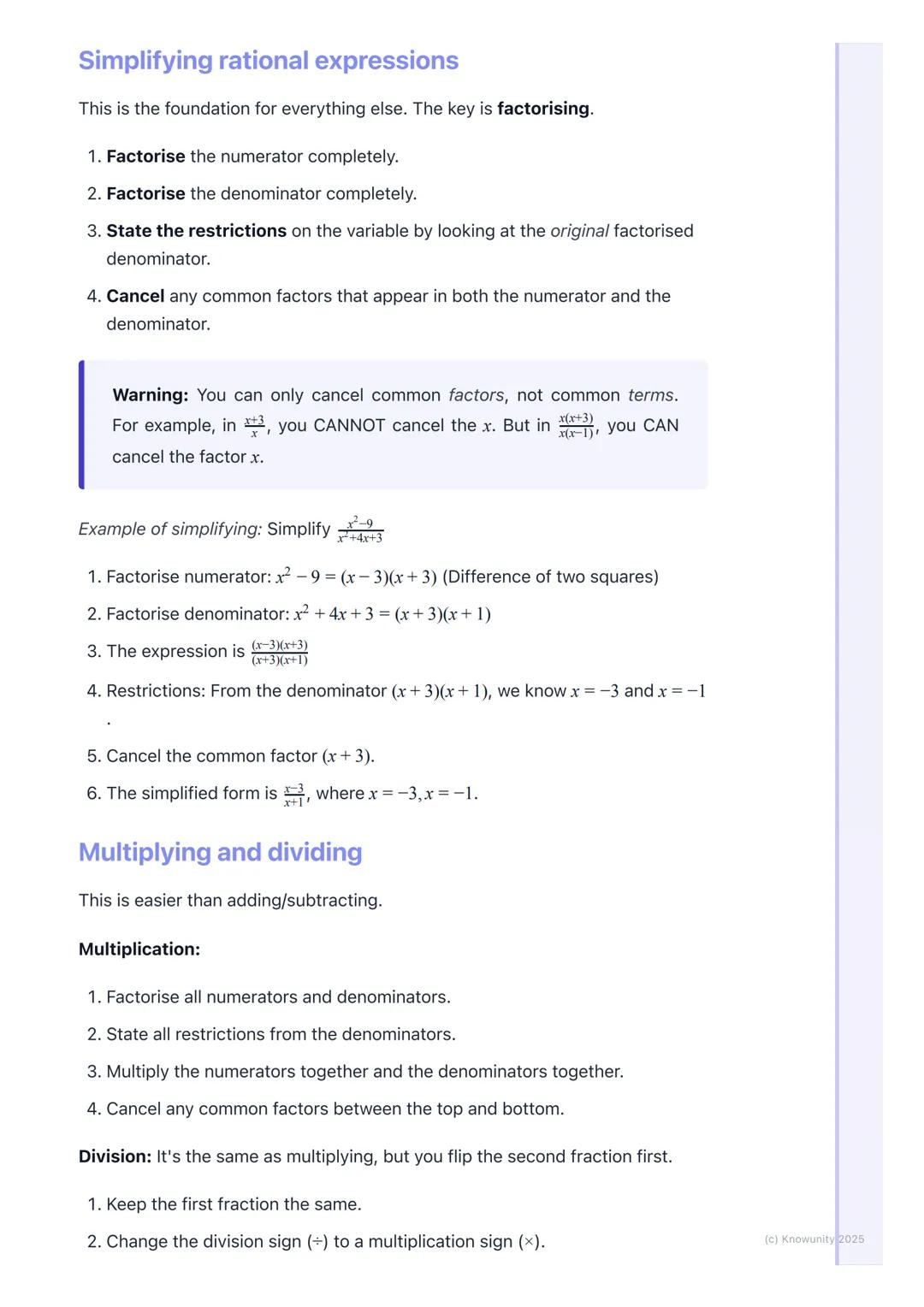
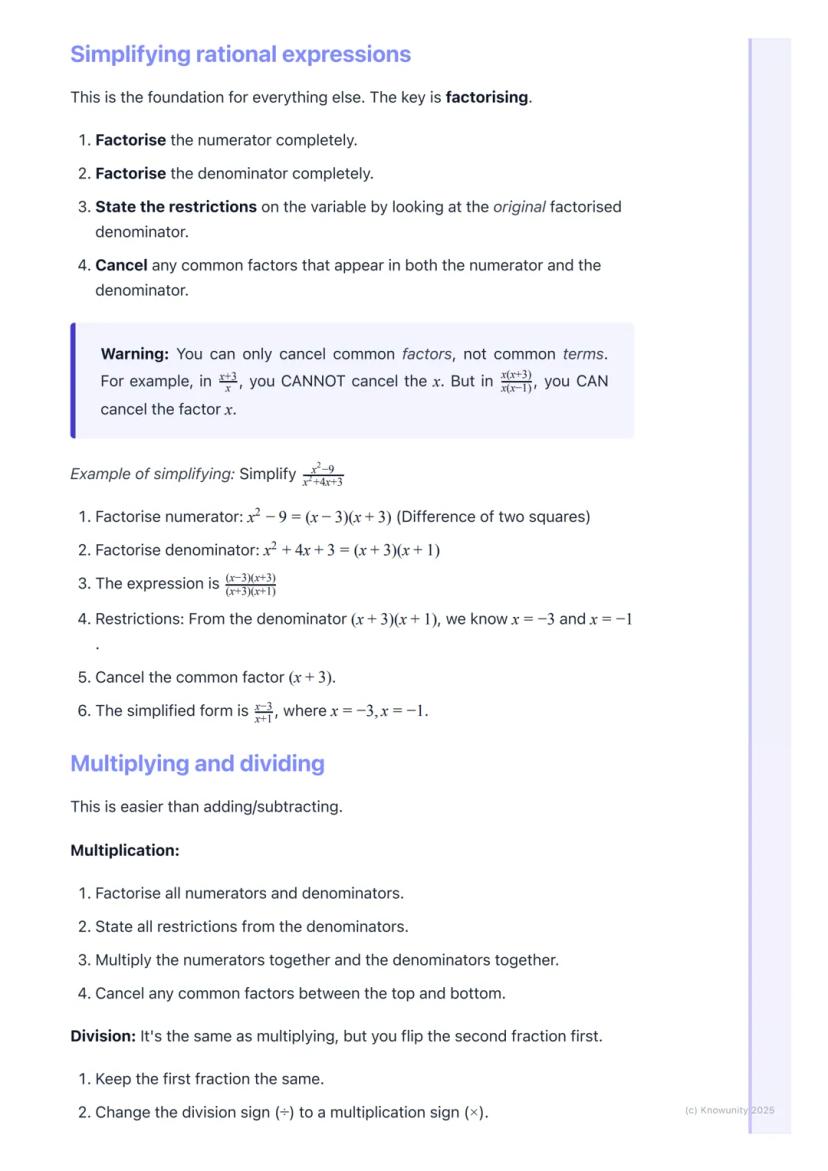
Simplifying Rational Expressions
This is where factorising becomes your best mate. The process is straightforward: factorise everything, state your restrictions, then cancel common factors (not terms!).
Let's break down . First, factorise the top: using difference of two squares. Then the bottom: .
Now you can see the common factor and cancel it out, giving you with restrictions x ≠ -3, x ≠ -1.
Warning: You can only cancel factors, never terms. Don't try cancelling the x in - that's mathematically wrong!
3
of 6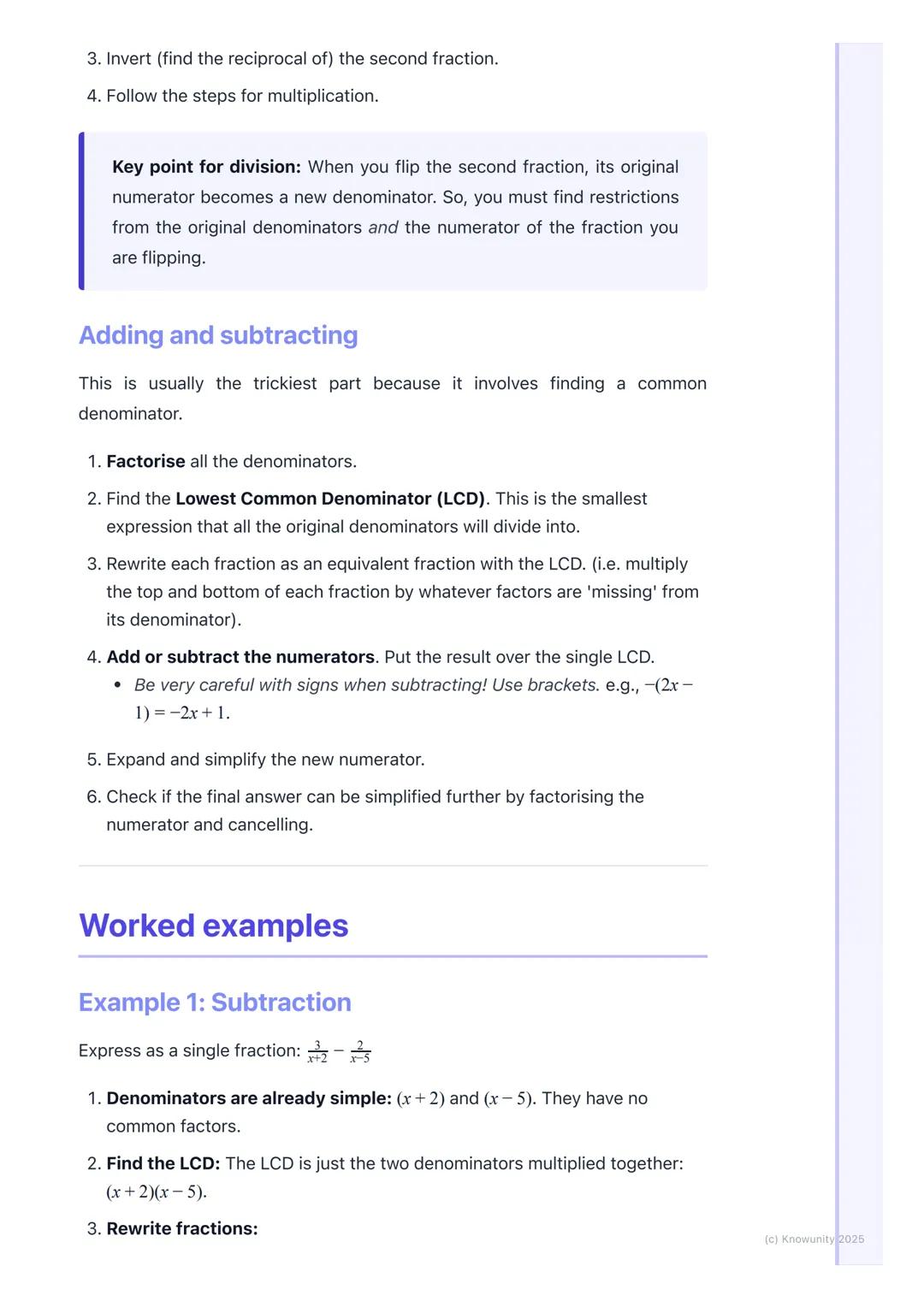
Multiplying and Dividing
Good news - this bit's actually easier than adding and subtracting! For multiplication, factorise everything first, then multiply tops together and bottoms together, and cancel any common factors.
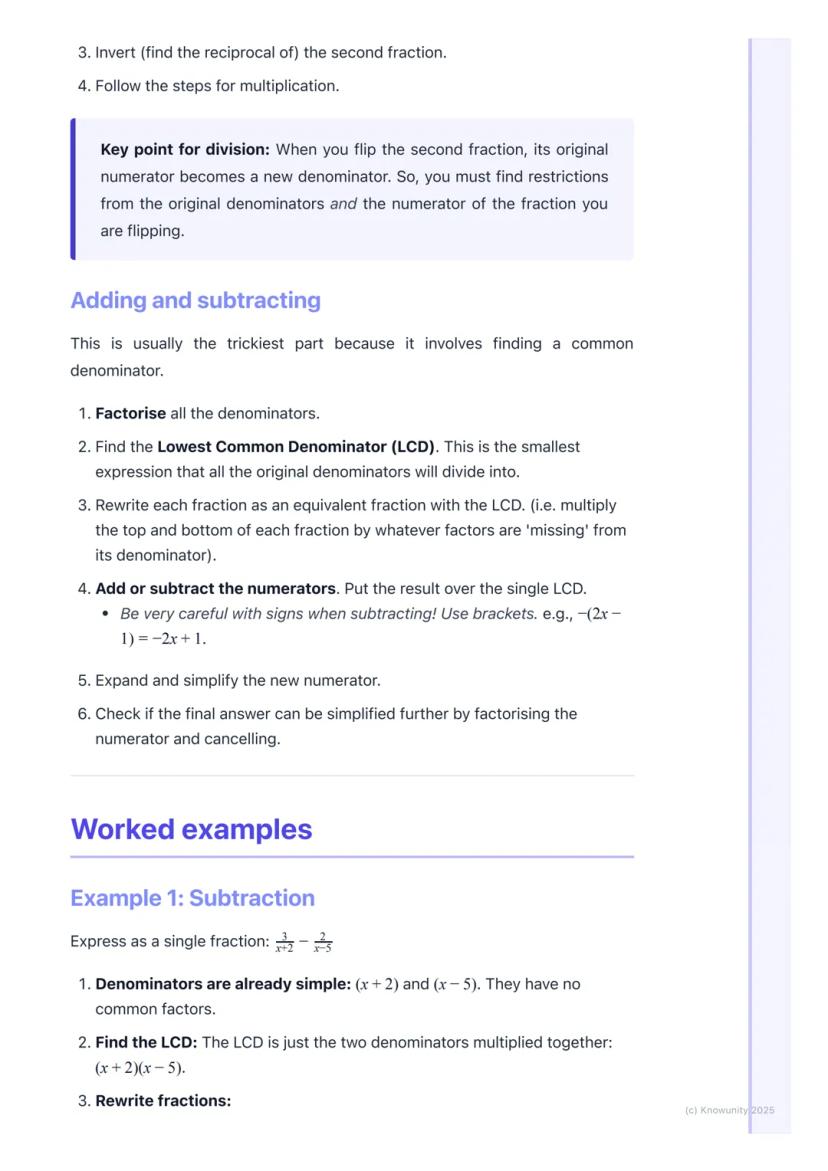
Division follows the classic "keep, change, flip" rule. Keep the first fraction as is, change the division sign to multiplication, then flip the second fraction. Just remember that when you flip a fraction, its original numerator becomes a new denominator, so you need restrictions from there too.
The key is staying organised - write down all your restrictions from every denominator (including the one you flipped) before you start cancelling.
Remember: Division is just multiplication in disguise - flip that second fraction and you're sorted!
4
of 6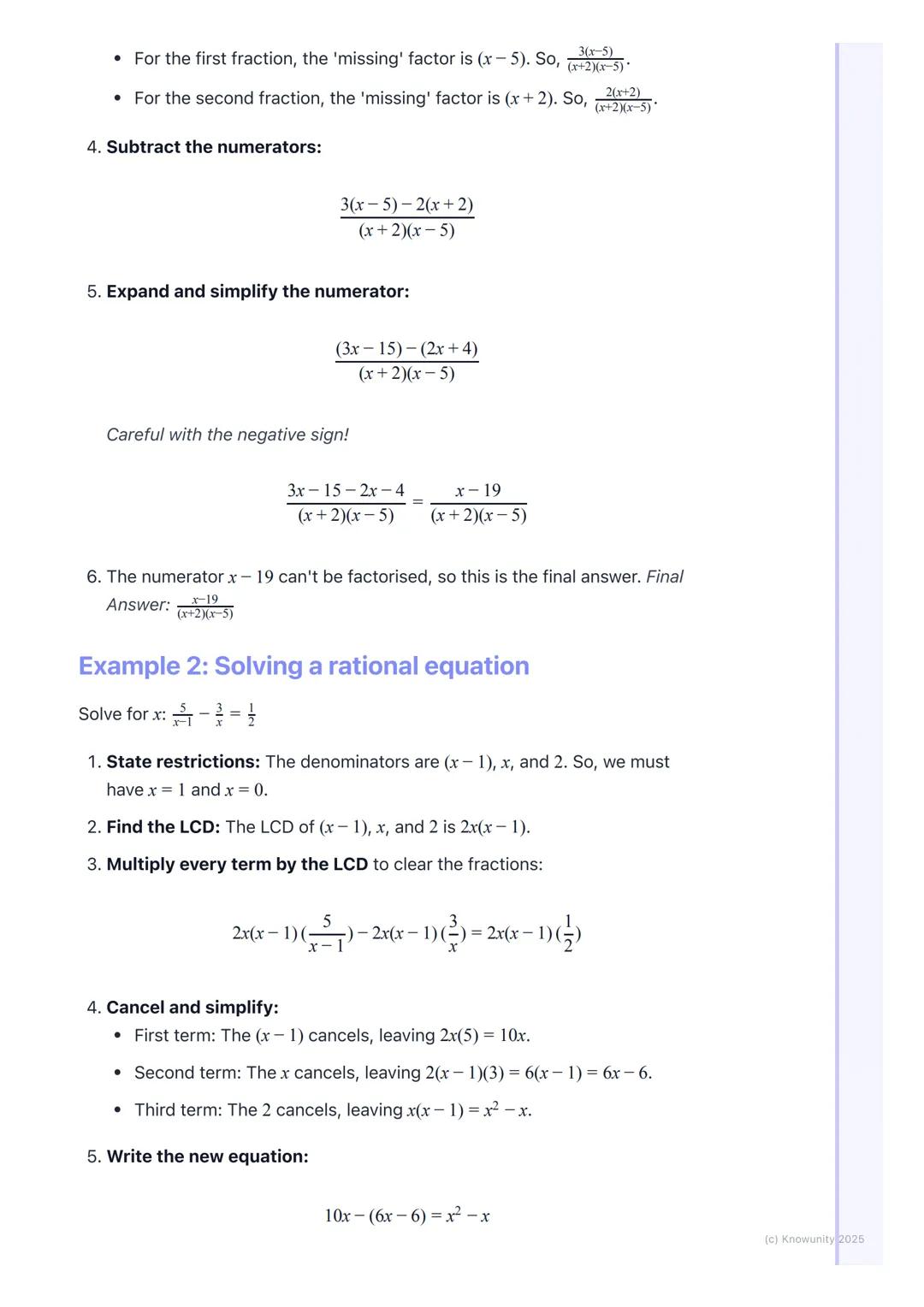
Adding and Subtracting
This is where things get properly tricky because you need a common denominator. Think of it like adding - you need a common bottom first.
Here's the step-by-step: factorise all denominators, find the LCD (lowest common denominator), rewrite each fraction with the LCD, then add or subtract the numerators. Be extra careful with negative signs - use brackets like .
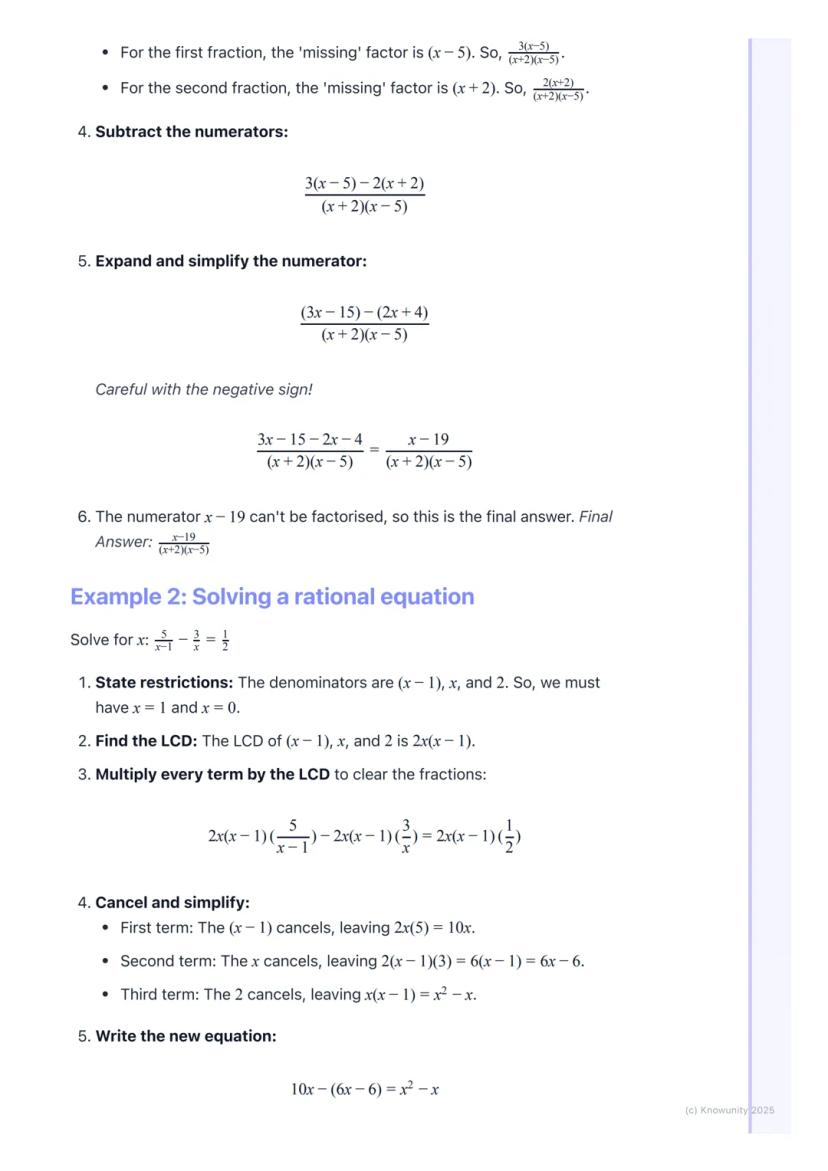
Let's try . The LCD is . Rewriting: . This gives us .
Top tip: When subtracting, always put brackets around the entire numerator you're subtracting to avoid sign errors!
5
of 6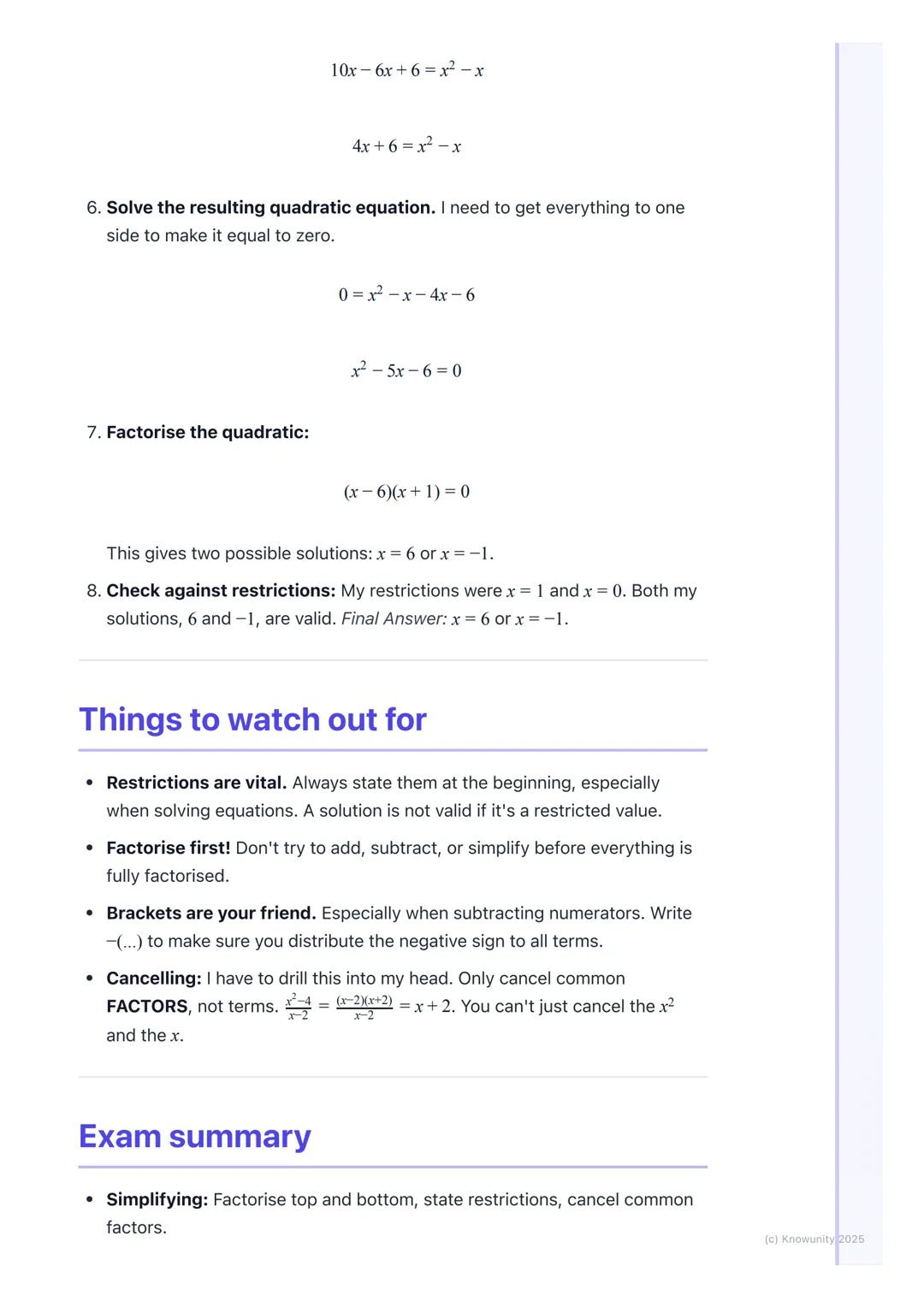
Solving Rational Equations
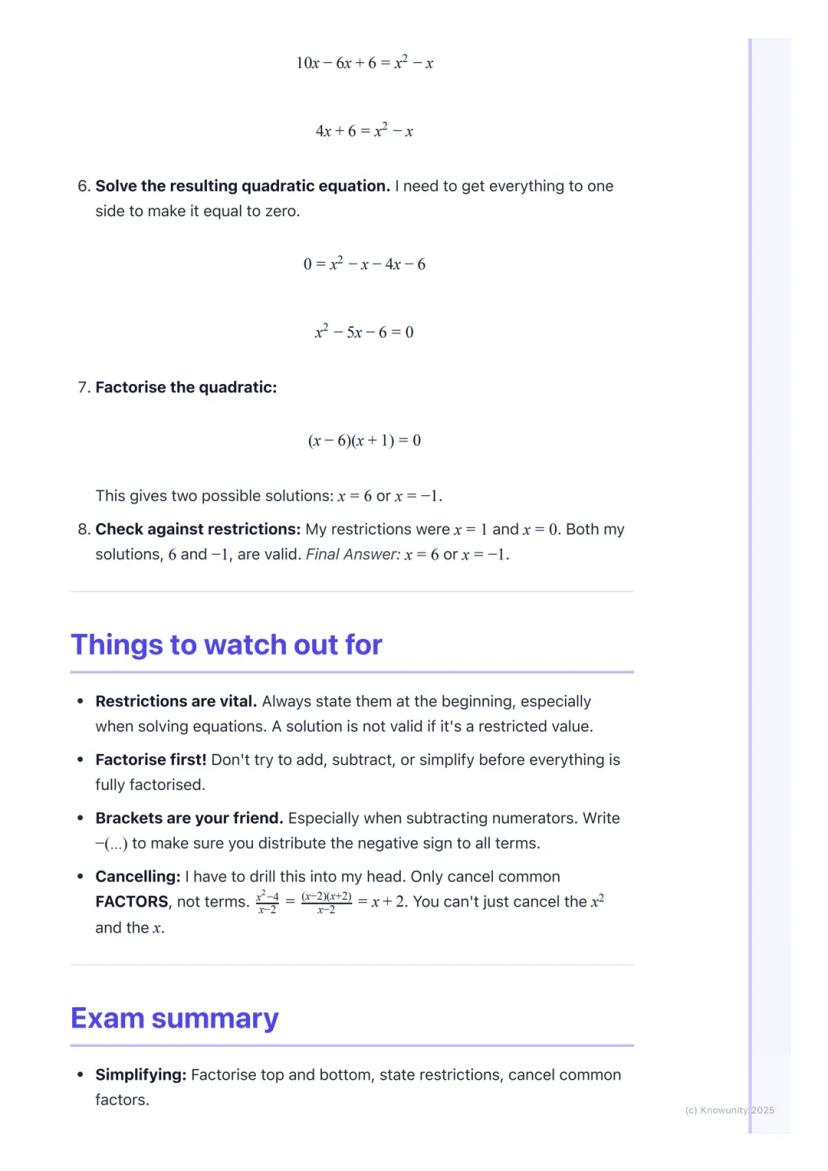
Now we're putting it all together! When solving equations like , your first job is stating all restrictions (x ≠ 1, x ≠ 0).
Next, find the LCD of all terms - here it's $2x10x - 6 = xx^2-5x-6=0$.
Factorising gives , so x = 6 or x = -1. Always check these solutions against your original restrictions - both are valid here since neither is 1 or 0.
Crucial step: Any solution that matches a restriction must be rejected - it's not a valid answer!
6
of 6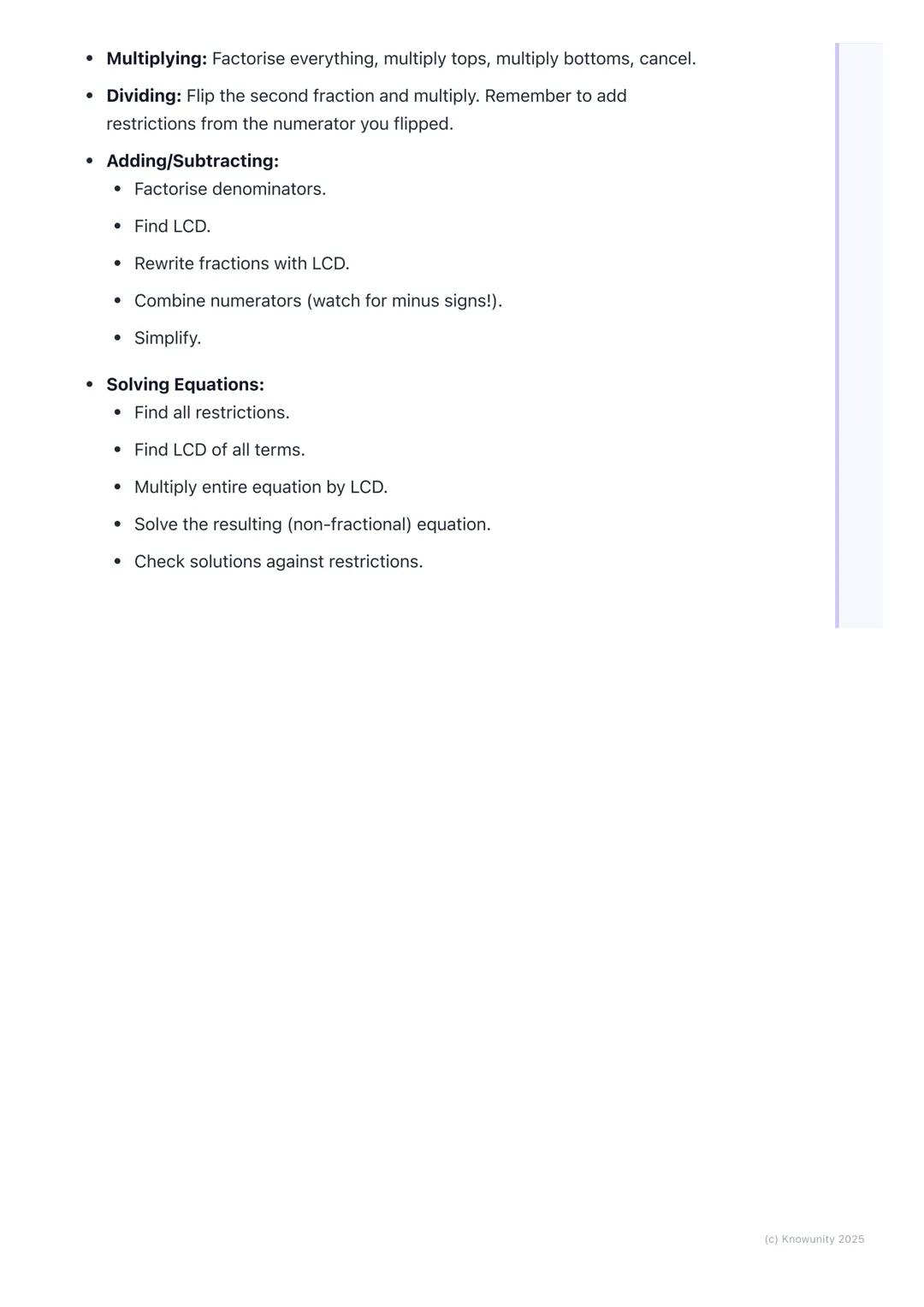
Exam Success Strategy
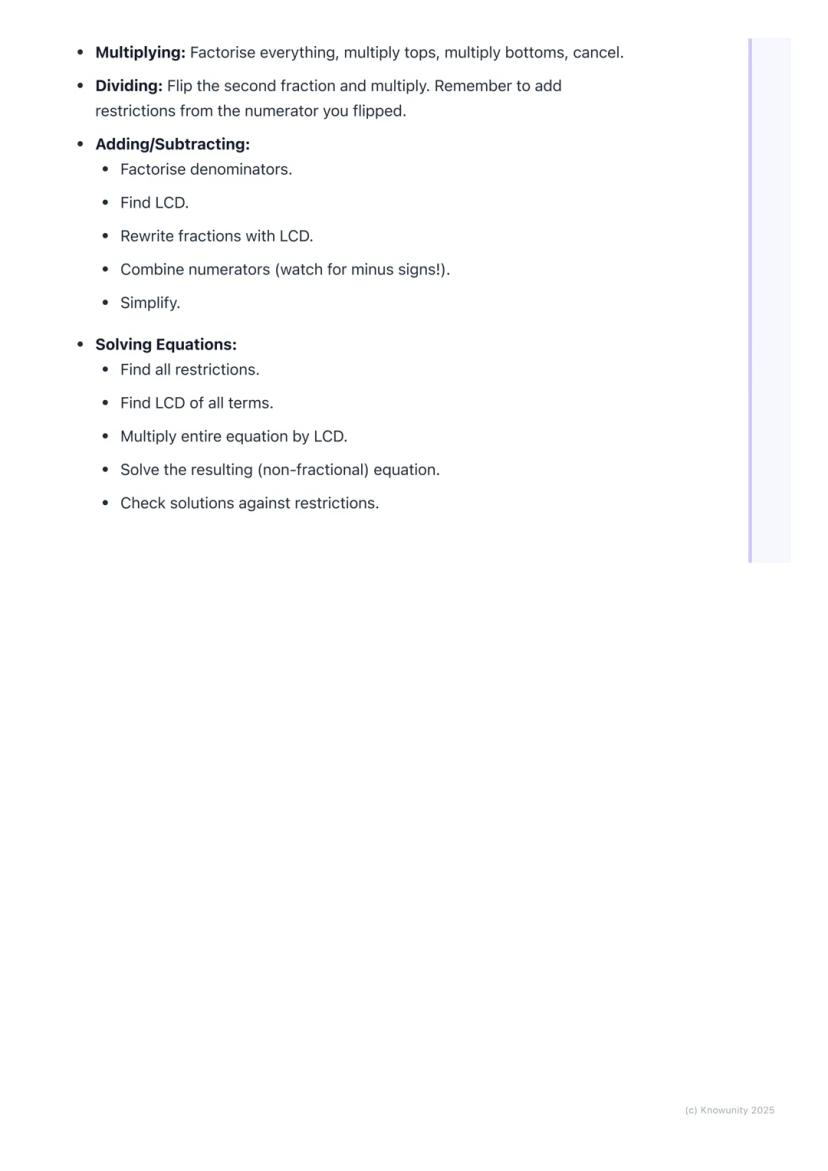
You've got this! Here's your quick reference for exam day: simplifying means factorise, state restrictions, then cancel factors. Multiplying is factorise everything, multiply across, then cancel. Dividing is flip and multiply.
For adding/subtracting, remember the mantra: factorise denominators, find LCD, rewrite fractions, combine carefully (watch those minus signs!), then simplify. Solving equations requires restrictions first, then clear fractions with the LCD.
The most common mistakes? Cancelling terms instead of factors, forgetting restrictions, and messing up signs when subtracting. Avoid these and you're golden.
Final reminder: Restrictions aren't just busy work - they'll save you from giving impossible answers that cost marks!
Pensamos que nunca lo preguntarías...
¿Qué es Knowunity AI companion?
Nuestro compañero de IA está específicamente adaptado a las necesidades de los estudiantes. Basándonos en los millones de contenidos que tenemos en la plataforma, podemos dar a los estudiantes respuestas realmente significativas y relevantes. Pero no se trata solo de respuestas, el compañero también guía a los estudiantes a través de sus retos de aprendizaje diarios, con planes de aprendizaje personalizados, cuestionarios o contenidos en el chat y una personalización del 100% basada en las habilidades y el desarrollo de los estudiantes.
¿Dónde puedo descargar la app Knowunity?
Puedes descargar la app en Google Play Store y Apple App Store.
¿Knowunity es totalmente gratuito?
¡Sí lo es! Tienes acceso totalmente gratuito a todo el contenido de la app, puedes chatear con otros alumnos y recibir ayuda inmeditamente. Puedes ganar dinero utilizando la aplicación, que te permitirá acceder a determinadas funciones.
Contenidos más populares de Mathematics
8Contenidos más populares
9¿No encuentras lo que buscas? Explora otros temas.
Mira lo que dicen nuestros usuarios. Les encantó — y a ti también te encantará.
4.6/5App Store
4.7/5Google Play
La app es muy fácil de usar y está muy bien diseñada. Hasta ahora he encontrado todo lo que estaba buscando y he podido aprender mucho de las presentaciones. Definitivamente utilizaré la aplicación para un examen de clase. Y, por supuesto, también me sirve mucho de inspiración.
Pablousuario de iOS
Esta app es realmente genial. Hay tantos apuntes de clase y ayuda [...]. Tengo problemas con matemáticas, por ejemplo, y la aplicación tiene muchas opciones de ayuda. Gracias a Knowunity, he mejorado en mates. Se la recomiendo a todo el mundo.
Elenausuaria de Android
Vaya, estoy realmente sorprendida. Acabo de probar la app porque la he visto anunciada muchas veces y me he quedado absolutamente alucinada. Esta app es LA AYUDA que quieres para el insti y, sobre todo, ofrece muchísimas cosas, como ejercicios y hojas informativas, que a mí personalmente me han sido MUY útiles.
Anausuaria de iOS
Mathematics5 visualizaciones·Actualizado May 31, 2026·6 páginasMastering Rational Expressions: Simplify, Solve, and Operate
Rational expressions are basically fractions with polynomials on top and bottom - think of them as regular fractions but with algebra thrown in. They're everywhere in maths, from solving real-world problems to advanced calculus, so getting comfortable with them now... Mostrar más
1
of 6Inscríbete para ver los apuntes. ¡Es gratis!
- Acceso a todos los documentos
- Mejora tus notas
- Únete a millones de estudiantes
What Are Rational Expressions?
Ever wondered what happens when you mix fractions with algebra? You get rational expressions - fractions where both the numerator and denominator are polynomials, like .
The golden rule here is that the denominator can never equal zero because dividing by zero is mathematically impossible. This creates what we call restrictions or non-permissible values - basically the values of x that would make the denominator zero.
Finding restrictions is dead simple: set the denominator equal to zero and solve. For example, with , the restriction is x = 4 because that makes the bottom 4-4 = 0.
Pro tip: Always find your restrictions first - they'll be crucial when solving equations later on!
2
of 6Inscríbete para ver los apuntes. ¡Es gratis!
- Acceso a todos los documentos
- Mejora tus notas
- Únete a millones de estudiantes
Simplifying Rational Expressions
This is where factorising becomes your best mate. The process is straightforward: factorise everything, state your restrictions, then cancel common factors (not terms!).
Let's break down . First, factorise the top: using difference of two squares. Then the bottom: .
Now you can see the common factor and cancel it out, giving you with restrictions x ≠ -3, x ≠ -1.
Warning: You can only cancel factors, never terms. Don't try cancelling the x in - that's mathematically wrong!
3
of 6Inscríbete para ver los apuntes. ¡Es gratis!
- Acceso a todos los documentos
- Mejora tus notas
- Únete a millones de estudiantes
Multiplying and Dividing
Good news - this bit's actually easier than adding and subtracting! For multiplication, factorise everything first, then multiply tops together and bottoms together, and cancel any common factors.
Division follows the classic "keep, change, flip" rule. Keep the first fraction as is, change the division sign to multiplication, then flip the second fraction. Just remember that when you flip a fraction, its original numerator becomes a new denominator, so you need restrictions from there too.
The key is staying organised - write down all your restrictions from every denominator (including the one you flipped) before you start cancelling.
Remember: Division is just multiplication in disguise - flip that second fraction and you're sorted!
4
of 6Inscríbete para ver los apuntes. ¡Es gratis!
- Acceso a todos los documentos
- Mejora tus notas
- Únete a millones de estudiantes
Adding and Subtracting
This is where things get properly tricky because you need a common denominator. Think of it like adding - you need a common bottom first.
Here's the step-by-step: factorise all denominators, find the LCD (lowest common denominator), rewrite each fraction with the LCD, then add or subtract the numerators. Be extra careful with negative signs - use brackets like .
Let's try . The LCD is . Rewriting: . This gives us .
Top tip: When subtracting, always put brackets around the entire numerator you're subtracting to avoid sign errors!
5
of 6Inscríbete para ver los apuntes. ¡Es gratis!
- Acceso a todos los documentos
- Mejora tus notas
- Únete a millones de estudiantes
Solving Rational Equations
Now we're putting it all together! When solving equations like , your first job is stating all restrictions (x ≠ 1, x ≠ 0).
Next, find the LCD of all terms - here it's $2x10x - 6 = xx^2-5x-6=0$.
Factorising gives , so x = 6 or x = -1. Always check these solutions against your original restrictions - both are valid here since neither is 1 or 0.
Crucial step: Any solution that matches a restriction must be rejected - it's not a valid answer!
6
of 6Inscríbete para ver los apuntes. ¡Es gratis!
- Acceso a todos los documentos
- Mejora tus notas
- Únete a millones de estudiantes
Exam Success Strategy
You've got this! Here's your quick reference for exam day: simplifying means factorise, state restrictions, then cancel factors. Multiplying is factorise everything, multiply across, then cancel. Dividing is flip and multiply.
For adding/subtracting, remember the mantra: factorise denominators, find LCD, rewrite fractions, combine carefully (watch those minus signs!), then simplify. Solving equations requires restrictions first, then clear fractions with the LCD.
The most common mistakes? Cancelling terms instead of factors, forgetting restrictions, and messing up signs when subtracting. Avoid these and you're golden.
Final reminder: Restrictions aren't just busy work - they'll save you from giving impossible answers that cost marks!
Pensamos que nunca lo preguntarías...
¿Qué es Knowunity AI companion?
Nuestro compañero de IA está específicamente adaptado a las necesidades de los estudiantes. Basándonos en los millones de contenidos que tenemos en la plataforma, podemos dar a los estudiantes respuestas realmente significativas y relevantes. Pero no se trata solo de respuestas, el compañero también guía a los estudiantes a través de sus retos de aprendizaje diarios, con planes de aprendizaje personalizados, cuestionarios o contenidos en el chat y una personalización del 100% basada en las habilidades y el desarrollo de los estudiantes.
¿Dónde puedo descargar la app Knowunity?
Puedes descargar la app en Google Play Store y Apple App Store.
¿Knowunity es totalmente gratuito?
¡Sí lo es! Tienes acceso totalmente gratuito a todo el contenido de la app, puedes chatear con otros alumnos y recibir ayuda inmeditamente. Puedes ganar dinero utilizando la aplicación, que te permitirá acceder a determinadas funciones.
Contenidos más populares de Mathematics
8Contenidos más populares
9¿No encuentras lo que buscas? Explora otros temas.
Mira lo que dicen nuestros usuarios. Les encantó — y a ti también te encantará.
4.6/5App Store
4.7/5Google Play
La app es muy fácil de usar y está muy bien diseñada. Hasta ahora he encontrado todo lo que estaba buscando y he podido aprender mucho de las presentaciones. Definitivamente utilizaré la aplicación para un examen de clase. Y, por supuesto, también me sirve mucho de inspiración.
Pablousuario de iOS
Esta app es realmente genial. Hay tantos apuntes de clase y ayuda [...]. Tengo problemas con matemáticas, por ejemplo, y la aplicación tiene muchas opciones de ayuda. Gracias a Knowunity, he mejorado en mates. Se la recomiendo a todo el mundo.
Elenausuaria de Android
Vaya, estoy realmente sorprendida. Acabo de probar la app porque la he visto anunciada muchas veces y me he quedado absolutamente alucinada. Esta app es LA AYUDA que quieres para el insti y, sobre todo, ofrece muchísimas cosas, como ejercicios y hojas informativas, que a mí personalmente me han sido MUY útiles.
Anausuaria de iOS