
The Cold War was one of the most important periods... Mostrar más
 History
 Irish
Irish English
Inscríbete para ver los apuntes¡Es gratis!
Acceso a todos los documentos
Mejora tus notas
Únete a millones de estudiantes
Asignaturas
Triangle Congruence and Similarity Theorems
Triangle Properties and Classification
Linear Equations and Graphs
Geometric Angle Relationships
Trigonometric Functions and Identities
Equation Solving Techniques
Circle Geometry Fundamentals
Division Operations and Methods
Basic Differentiation Rules
Exponent and Logarithm Properties
Mostrar todos los temas
Human Organ Systems
Reproductive Cell Cycles
Biological Sciences Subdisciplines
Cellular Energy Metabolism
Autotrophic Energy Processes
Inheritance Patterns and Principles
Biomolecular Structure and Organization
Cell Cycle and Division Mechanics
Cellular Organization and Development
Biological Structural Organization
Mostrar todos los temas
Chemical Sciences and Applications
Atomic Structure and Composition
Molecular Electron Structure Representation
Atomic Electron Behavior
Matter Properties and Water
Mole Concept and Calculations
Gas Laws and Behavior
Periodic Table Organization
Chemical Thermodynamics Fundamentals
Chemical Bond Types and Properties
Mostrar todos los temas
European Renaissance and Enlightenment
European Cultural Movements 800-1920
American Revolution Era 1763-1797
American Civil War 1861-1865
Global Imperial Systems
Mongol and Chinese Dynasties
U.S. Presidents and World Leaders
Historical Sources and Documentation
World Wars Era and Impact
World Religious Systems
Mostrar todos los temas
Classic and Contemporary Novels
Literary Character Analysis
Rhetorical Theory and Practice
Classic Literary Narratives
Reading Analysis and Interpretation
Narrative Structure and Techniques
English Language Components
Influential English-Language Authors
Basic Sentence Structure
Narrative Voice and Perspective
Mostrar todos los temas
22
•
Actualizado Apr 30, 2026
•
The Cold War was one of the most important periods... Mostrar más
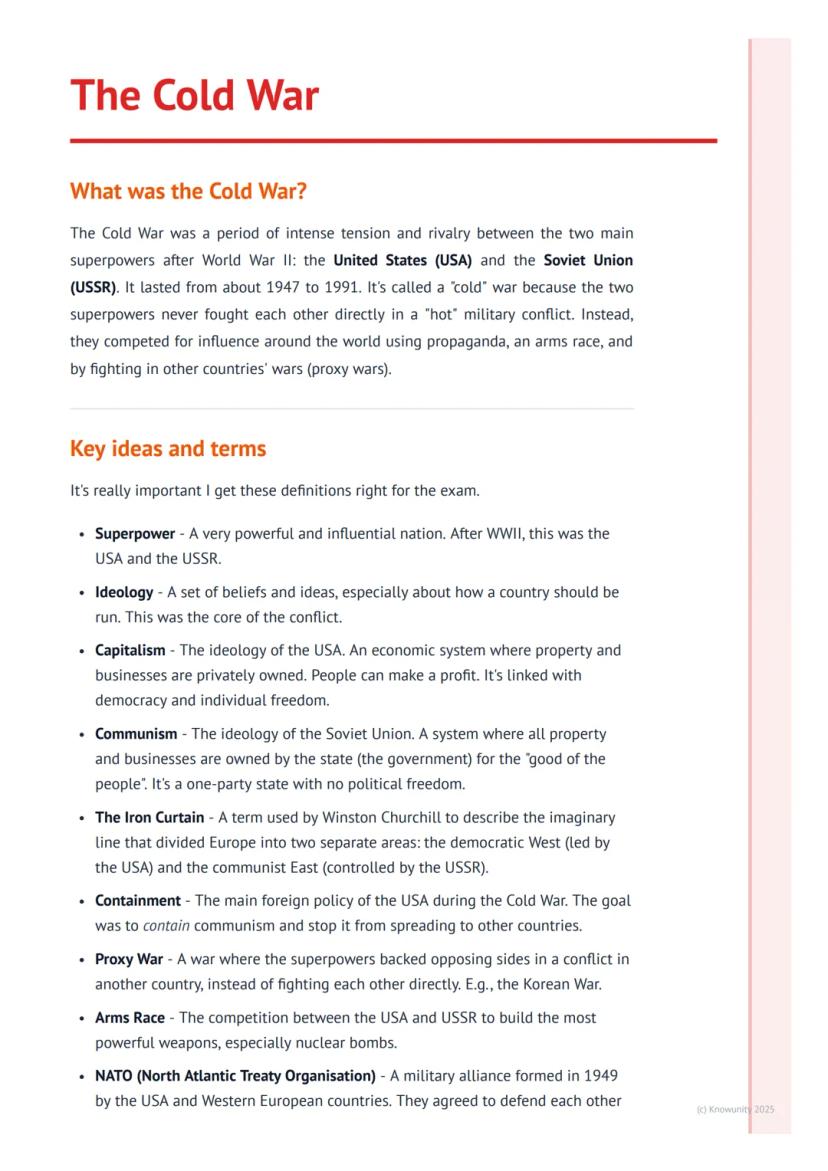
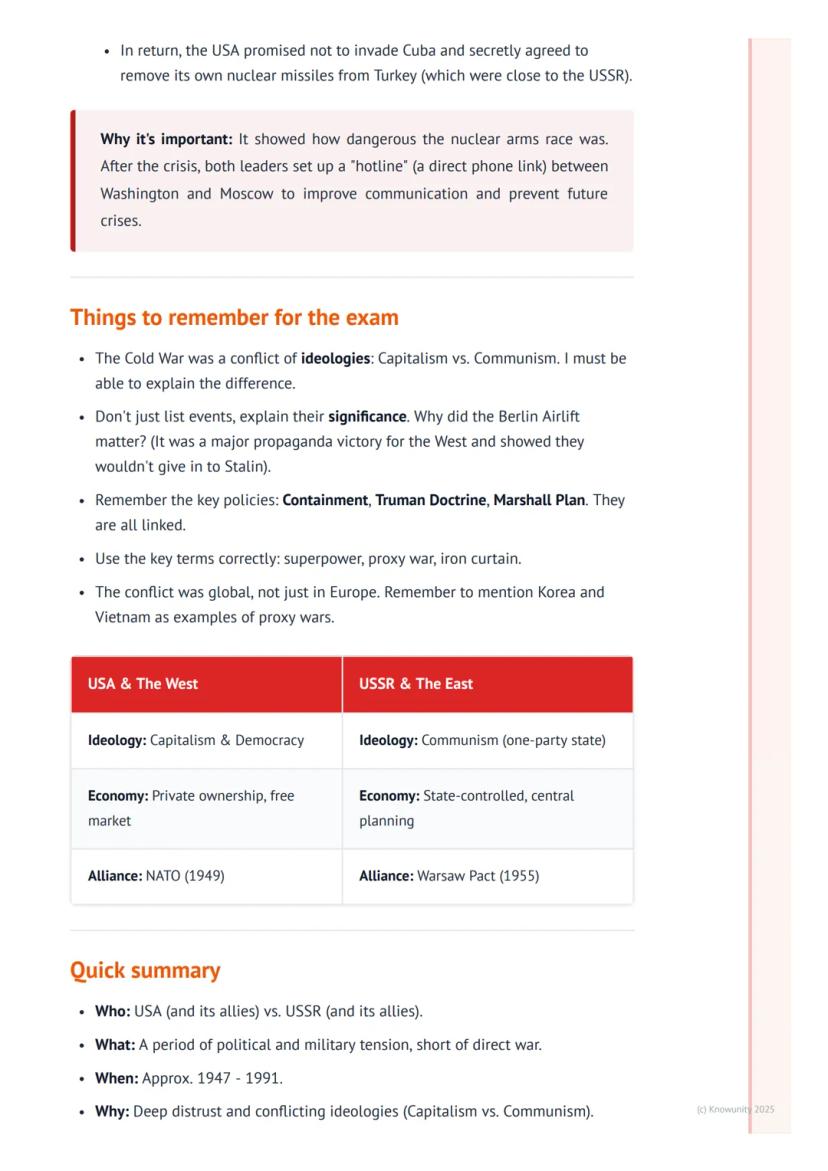
Ever wondered why it's called a "cold" war when tensions were so heated? The Cold War was the period of intense rivalry between the USA and USSR after World War II, but they never actually fought each other directly in battle.
Instead of tanks and soldiers clashing, these two superpowers competed through propaganda, spying, and backing opposite sides in other countries' conflicts. Think of it like two football rivals who never play each other but constantly try to prove who's better by beating everyone else.
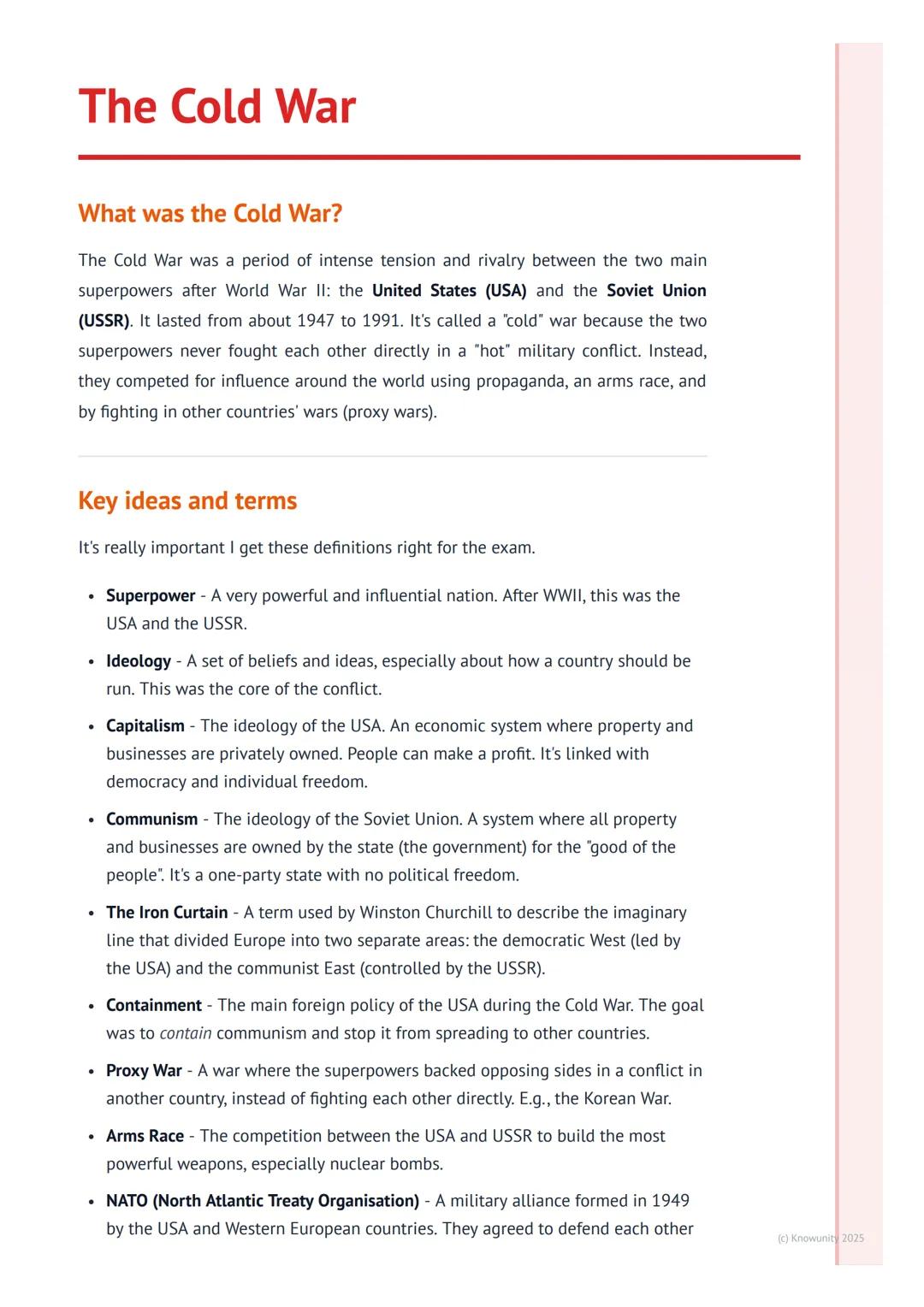
The real fight was about ideology - completely different ideas about how countries should be run. The USA championed capitalism (private ownership, free markets, democracy), whilst the USSR promoted communism . These opposing beliefs would drive nearly half a century of global tension.
Key Point: The Cold War wasn't just about politics - it affected everything from space exploration to sports, dividing the entire world into two opposing camps.
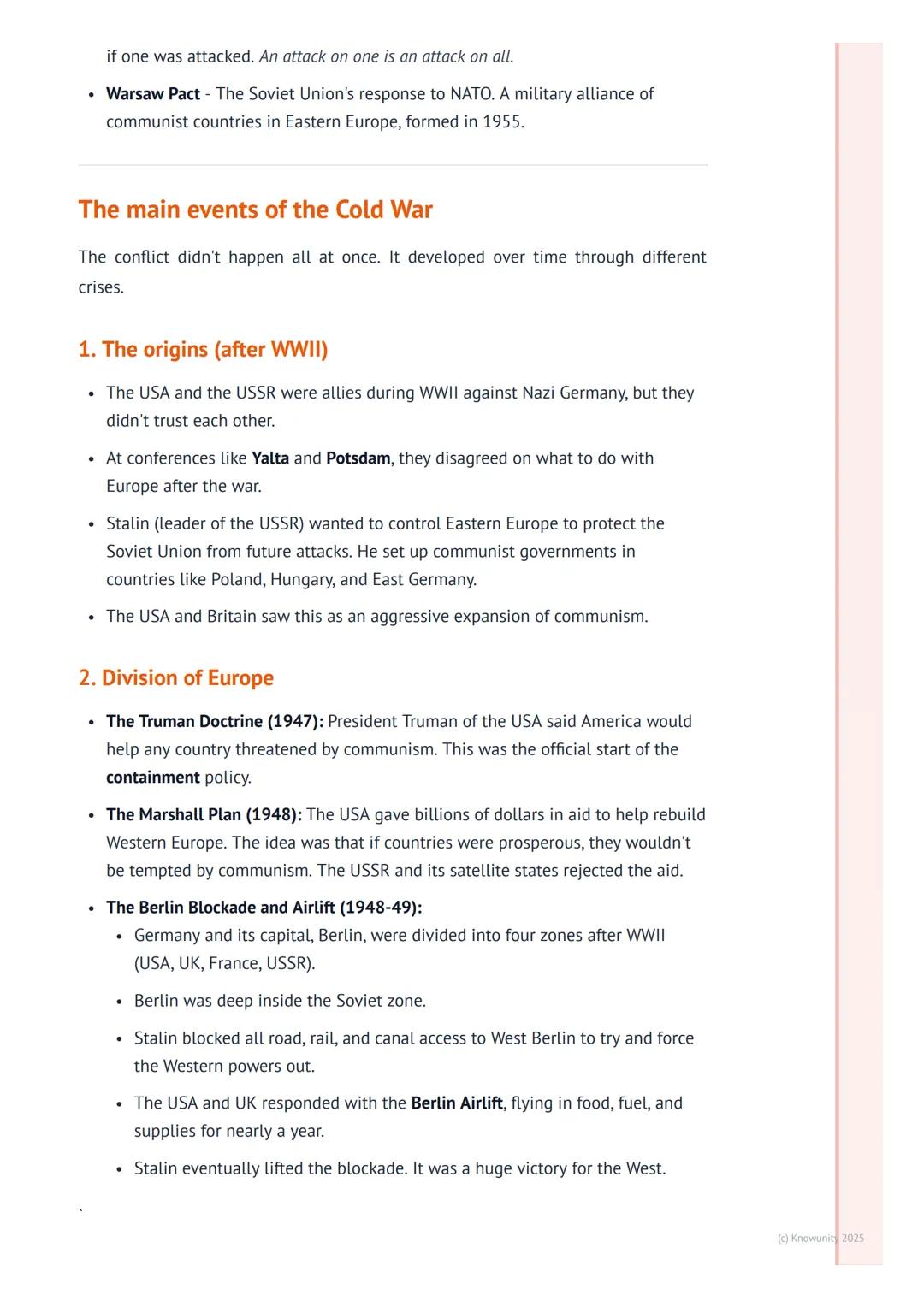
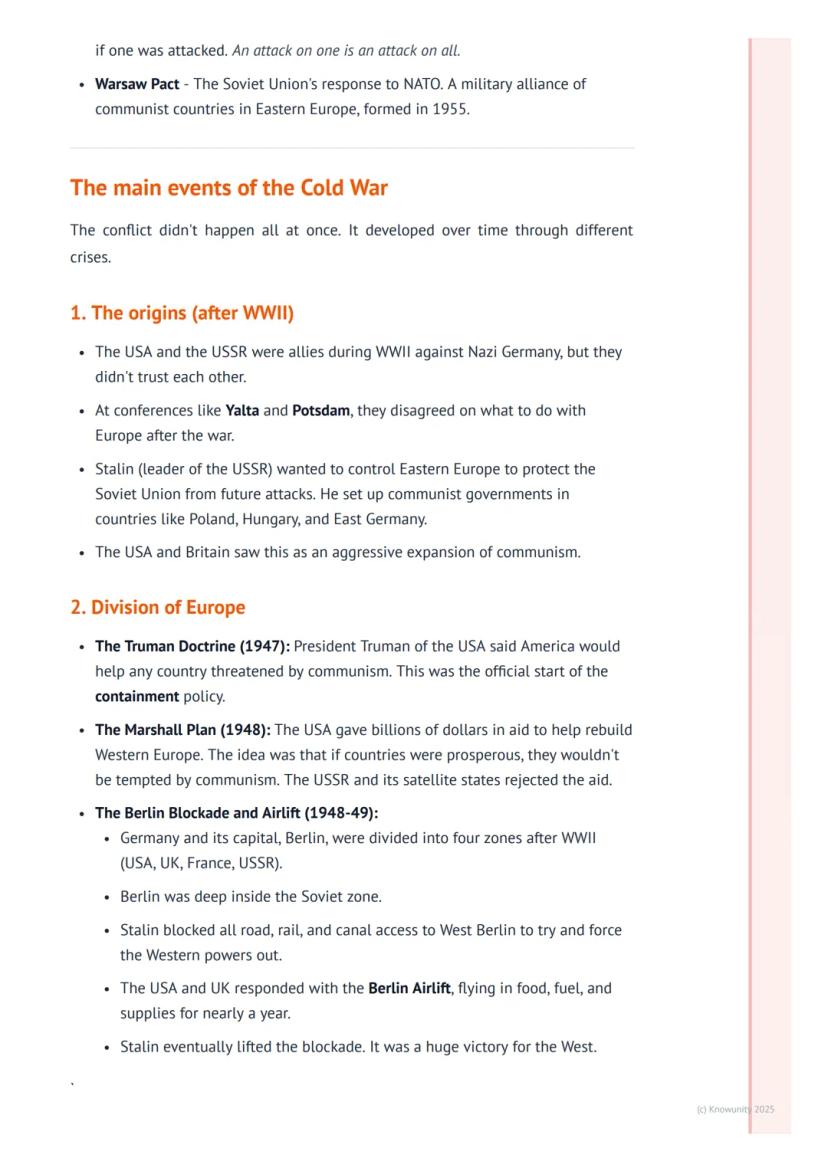
Right after WWII ended, former allies became bitter enemies. Stalin wanted to control Eastern Europe to protect Russia from future attacks, so he installed communist governments across countries like Poland and Hungary.
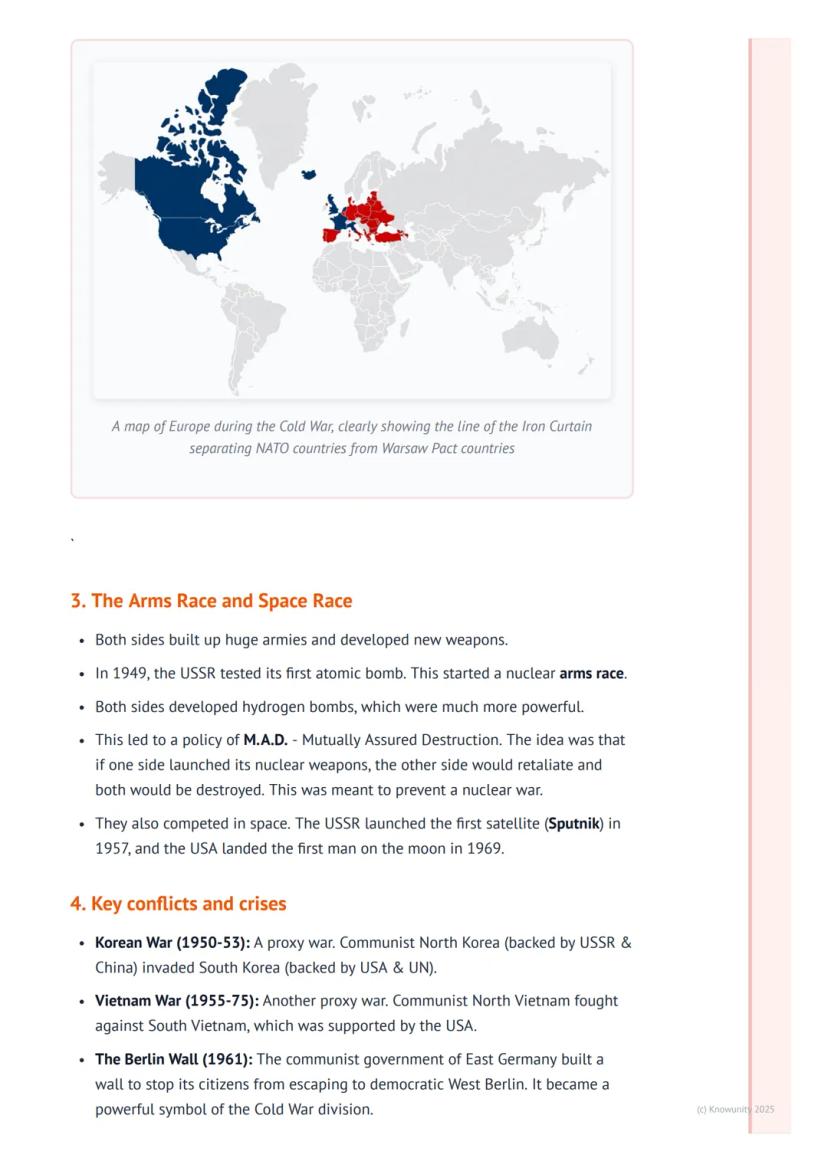
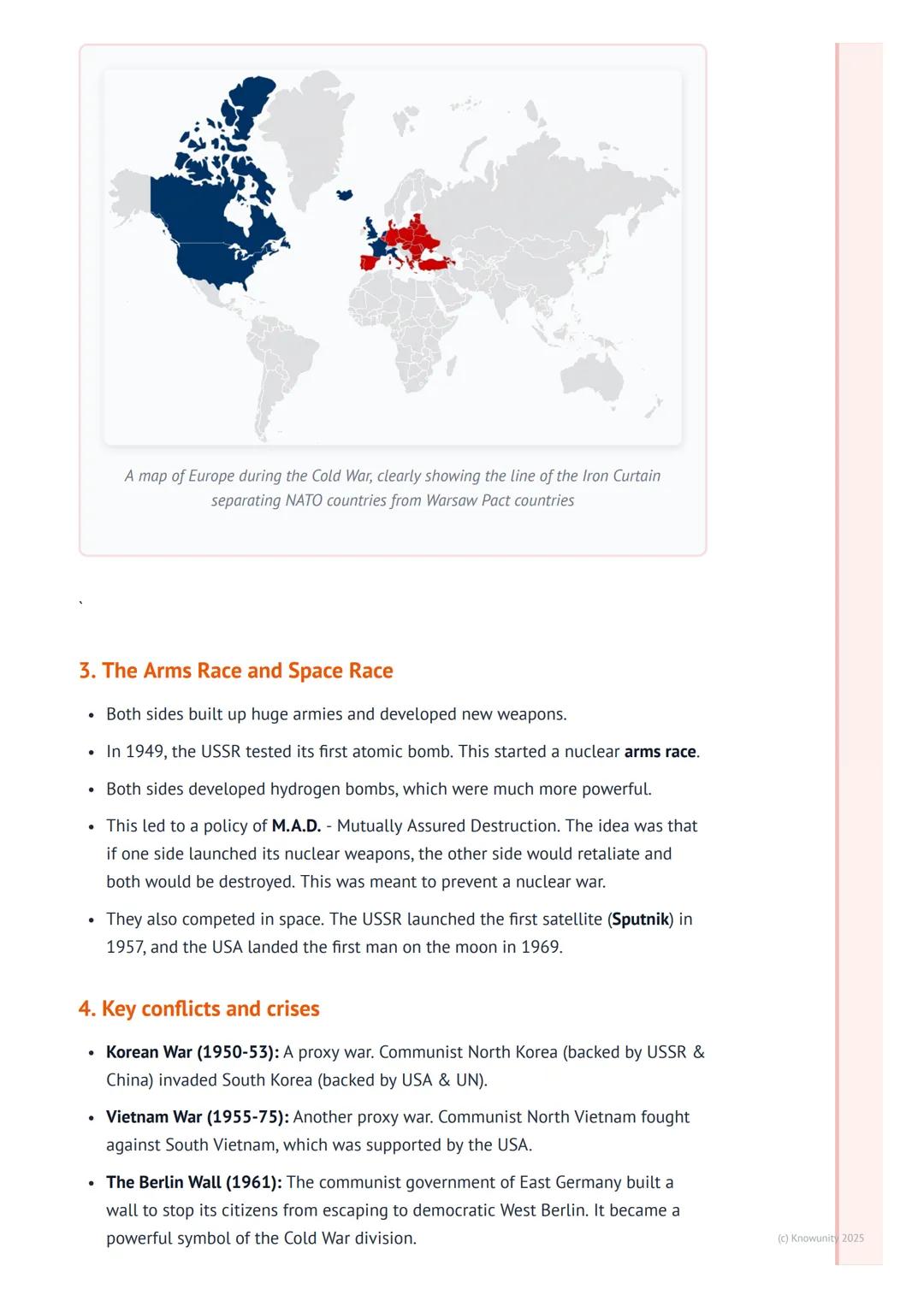
The West saw this as aggressive expansion. Winston Churchill famously described an "Iron Curtain" falling across Europe, separating the democratic West from the communist East. This wasn't an actual wall - it was an invisible line that divided families, friends, and entire nations.
America responded with the Truman Doctrine in 1947, promising to help any country threatened by communism. This containment policy became America's main strategy throughout the Cold War. The Marshall Plan followed, pumping billions of dollars into rebuilding Western Europe - because prosperous countries were less likely to turn communist.
The first major showdown came with the Berlin Blockade (1948-49). Stalin cut off all access to West Berlin, but America and Britain responded with a massive airlift, flying in supplies for nearly a year until Stalin backed down.
Remember This: The Truman Doctrine and Marshall Plan weren't just generous gestures - they were strategic moves to stop communism spreading westward.
The 1950s and 60s saw an terrifying nuclear arms race. When the USSR tested its first atomic bomb in 1949, both sides began building increasingly powerful weapons. This led to M.A.D. - Mutually Assured Destruction - the terrifying logic that neither side would start a nuclear war because both would be completely destroyed.
The superpowers also fought proxy wars - backing opposing sides in conflicts around the world rather than fighting directly. The Korean War (1950-53) saw communist North Korea battle American-backed South Korea. The Vietnam War dragged on even longer, becoming America's longest and most controversial conflict of the era.
Meanwhile, the Berlin Wall went up in 1961, physically dividing East and West Berlin. Families were separated overnight, and the wall became the most powerful symbol of Cold War division. East German guards shot anyone trying to escape to the West.
The Cuban Missile Crisis in 1962 brought the world closest to nuclear war. For 13 terrifying days, American and Soviet leaders played a deadly game of brinkmanship over Soviet missiles in Cuba, just 90 miles from Florida.
Exam Tip: Don't just memorise dates - understand why these events mattered and how they increased or decreased tensions between the superpowers.
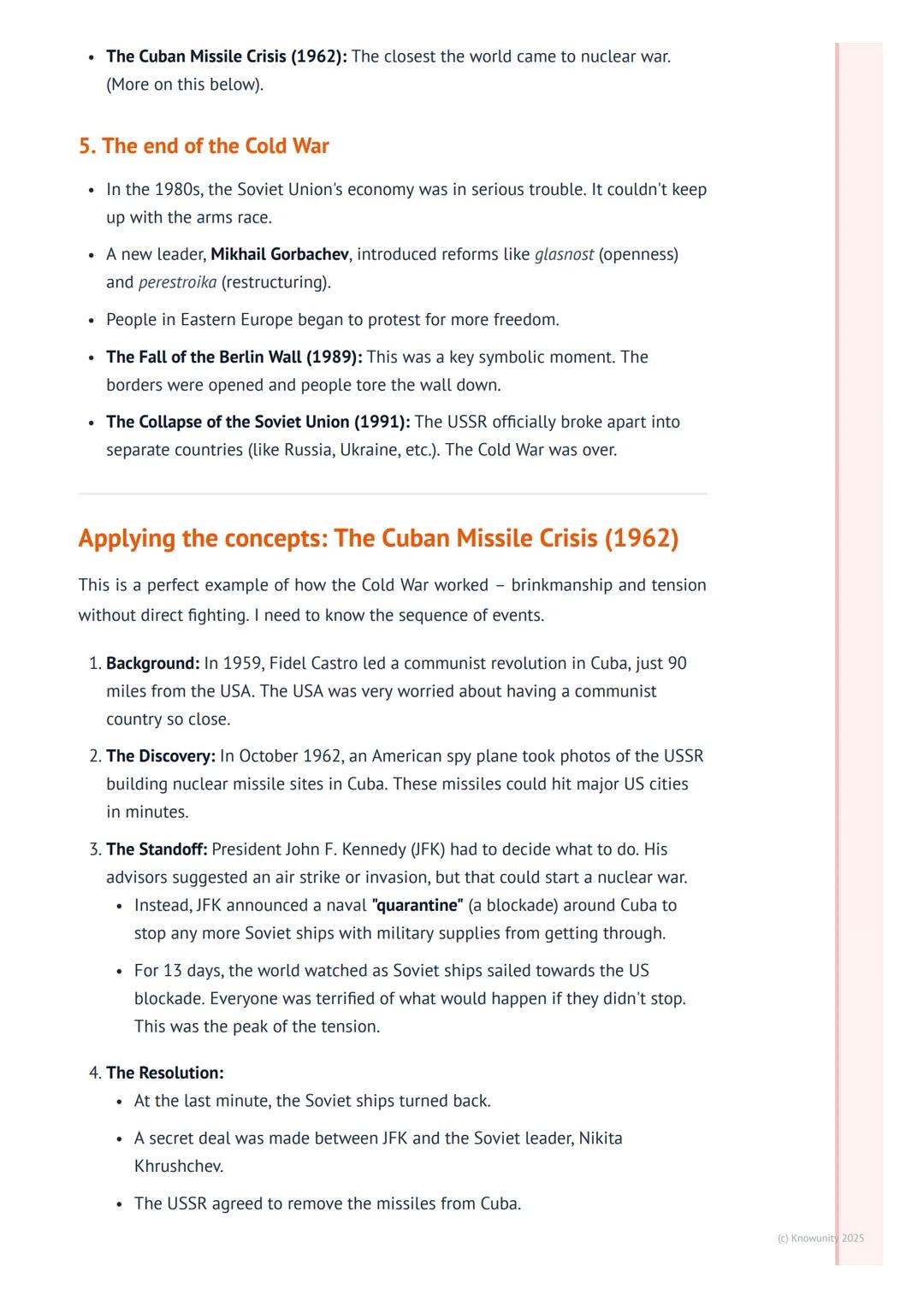
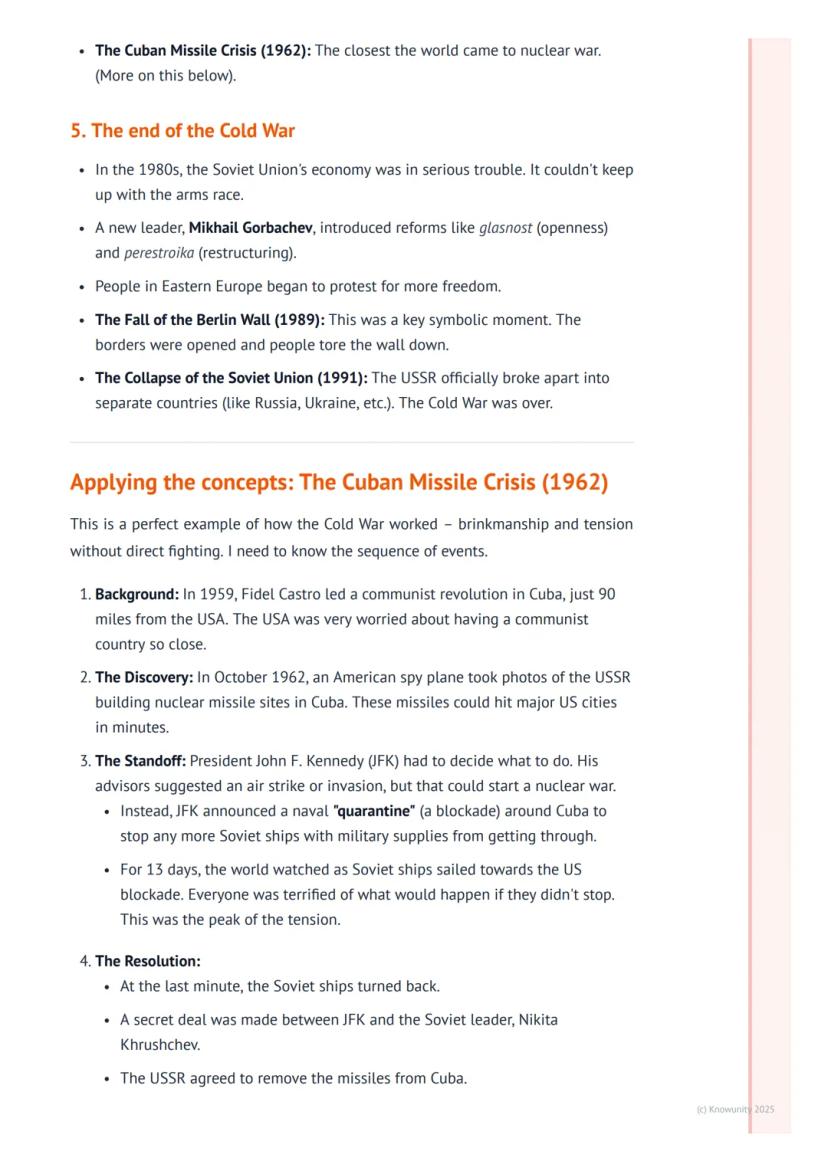
October 1962 was the most dangerous moment in human history. American spy planes discovered Soviet nuclear missiles being installed in Cuba, capable of hitting major US cities within minutes of launch.
President John F. Kennedy faced an impossible choice. Military advisors wanted to bomb the sites or invade Cuba, but that could trigger World War III. Instead, JFK announced a naval blockade around Cuba, stopping Soviet ships from delivering more weapons.
For 13 days, the world held its breath as Soviet ships approached the American blockade. Would they stop or force their way through? Nuclear submarines lurked beneath the waves, and both sides' militaries were on highest alert.
Finally, Soviet leader Khrushchev blinked first. The ships turned back, and a secret deal was struck: Russia would remove missiles from Cuba, America would promise not to invade Cuba, and secretly remove its own missiles from Turkey. The crisis established a "hotline" between Washington and Moscow to prevent future misunderstandings.
Why It Matters: The Cuban Missile Crisis showed how quickly the Cold War could turn hot - and how important communication was in preventing nuclear disaster.
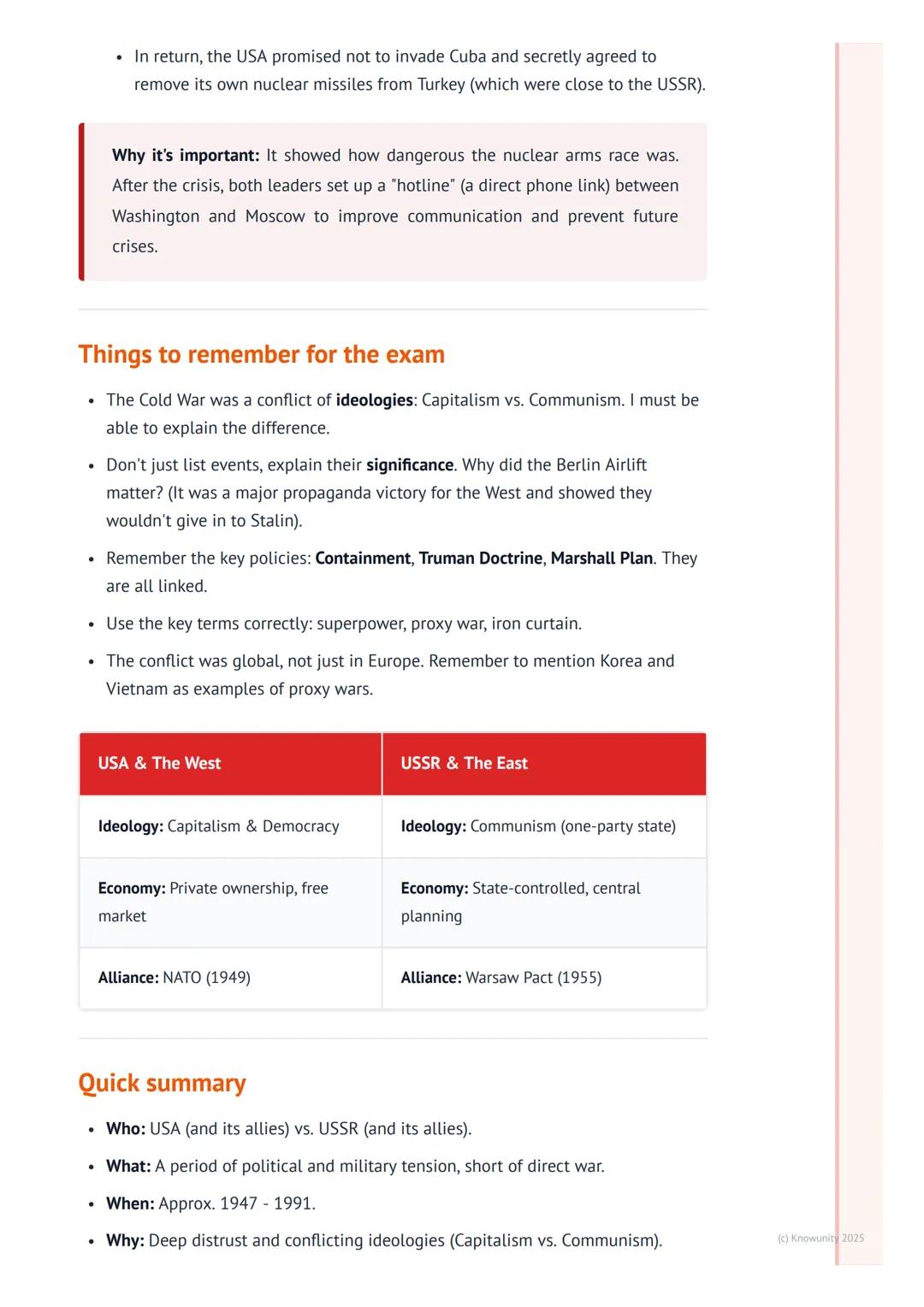
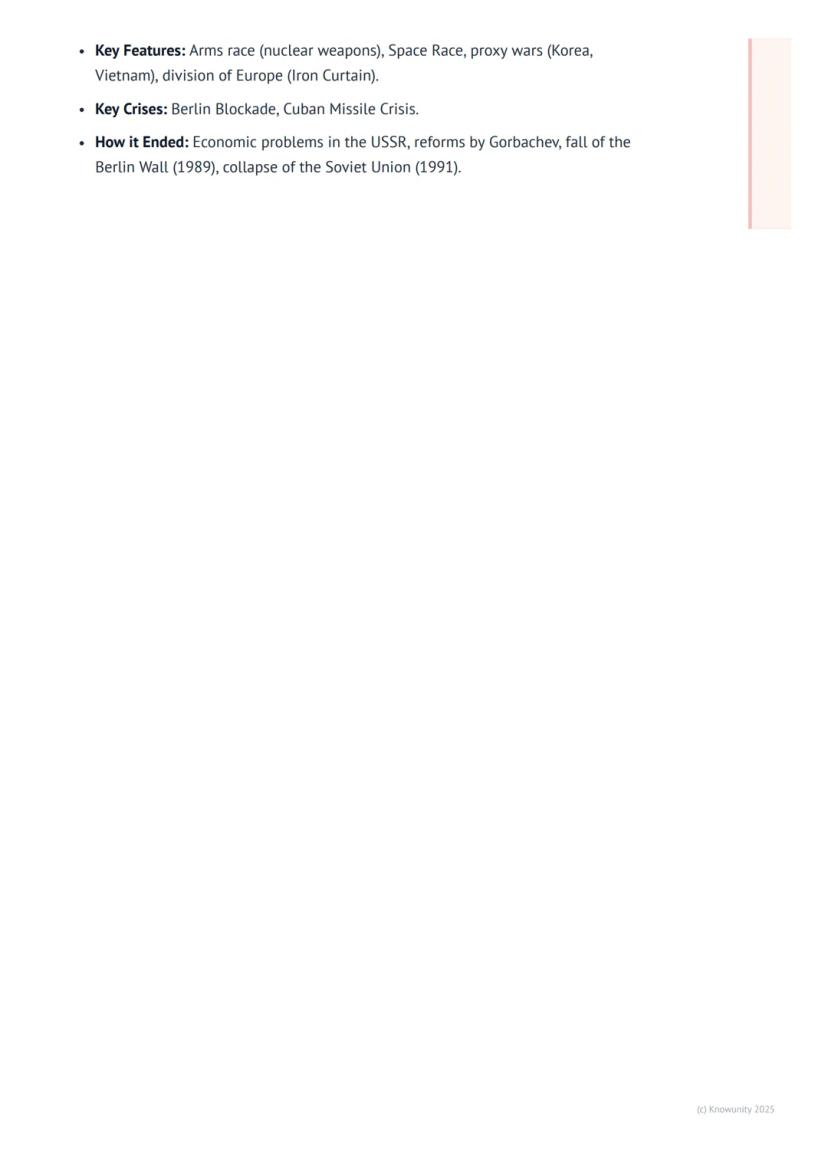
Both sides built military alliances to strengthen their positions. NATO (North Atlantic Treaty Organisation) formed in 1949, uniting America with Western European countries under the principle that an attack on one was an attack on all. The Soviets responded with the Warsaw Pact in 1955, binding Eastern European communist countries together.
The competition extended beyond Earth into space. The USSR shocked the world by launching Sputnik, the first satellite, in 1957. This space race became another front in the Cold War, with each side trying to prove their technological superiority.
America eventually won this particular contest by landing the first humans on the moon in 1969, but the space race pushed both nations to incredible technological achievements that benefit us today.
Throughout this period, both sides used propaganda, spying, and economic pressure to gain advantages. The KGB and CIA became household names as secret agents operated across the globe, gathering intelligence and supporting friendly governments.
Think About It: Many technologies we use daily - from GPS to the internet - originated from Cold War military research and the space race.
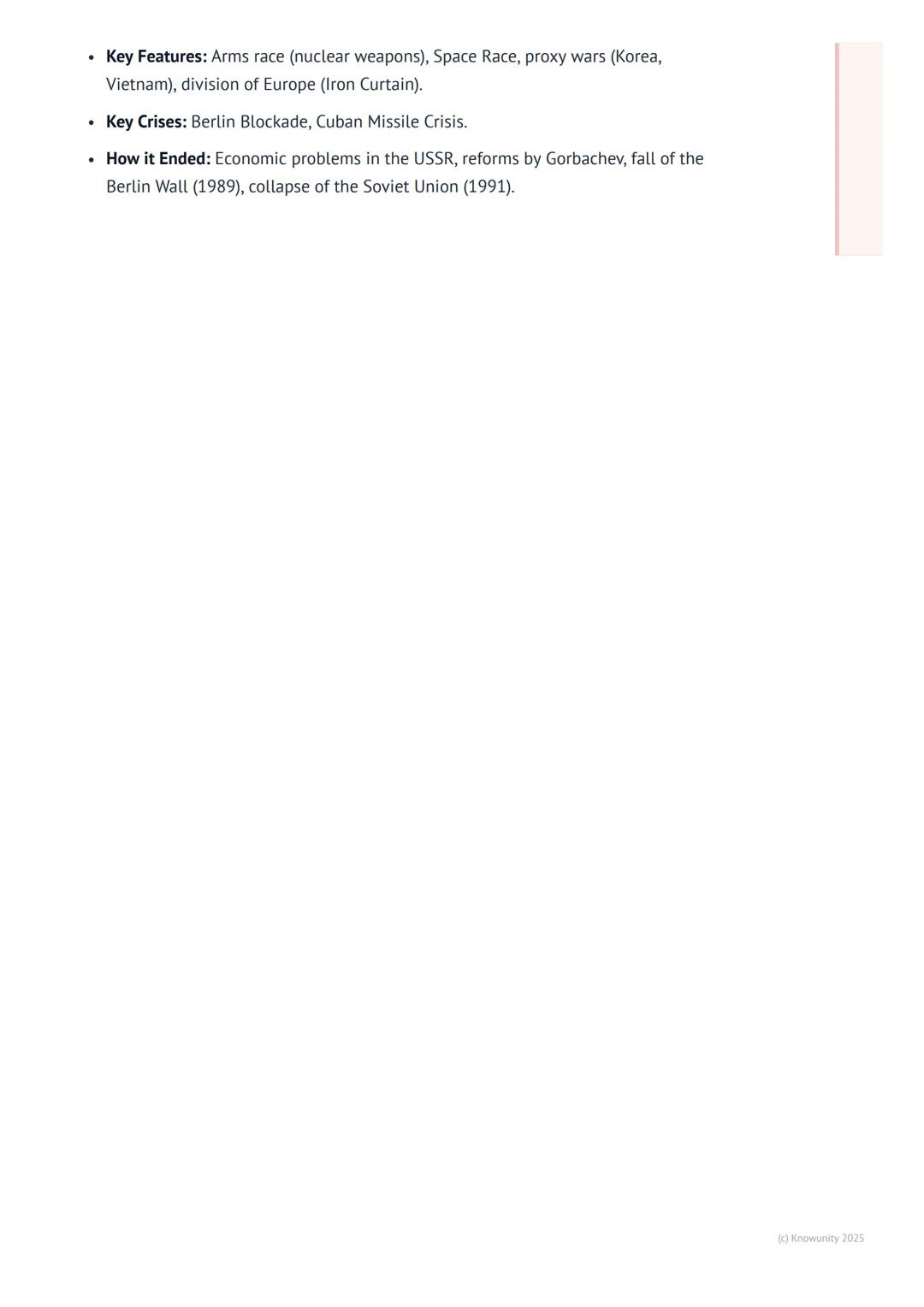
By the 1980s, the Soviet Union was cracking under pressure. The arms race had drained their economy, and their outdated system couldn't compete with Western prosperity. When Mikhail Gorbachev became Soviet leader, he introduced glasnost (openness) and perestroika (restructuring) to save the system.
Instead, these reforms unleashed forces that destroyed Soviet control. People across Eastern Europe demanded freedom, and communist governments began toppling like dominoes. The most symbolic moment came in 1989 when the Berlin Wall fell, with ordinary citizens taking sledgehammers to the concrete barrier that had divided their city for 28 years.
The Soviet Union officially collapsed in 1991, splitting into separate countries like Russia, Ukraine, and the Baltic states. The Cold War was finally over, leaving America as the world's only superpower.
The Cold War's end didn't solve all global problems, but it removed the constant threat of nuclear annihilation that had haunted two generations. Understanding this period helps explain many current world issues, from NATO expansion to tensions with Russia.
For Your Exams: Focus on key turning points, understand the difference between capitalism and communism, and be able to explain how specific events like the Berlin Airlift showed the broader conflict between the superpowers.
Nuestro compañero de IA está específicamente adaptado a las necesidades de los estudiantes. Basándonos en los millones de contenidos que tenemos en la plataforma, podemos dar a los estudiantes respuestas realmente significativas y relevantes. Pero no se trata solo de respuestas, el compañero también guía a los estudiantes a través de sus retos de aprendizaje diarios, con planes de aprendizaje personalizados, cuestionarios o contenidos en el chat y una personalización del 100% basada en las habilidades y el desarrollo de los estudiantes.
Puedes descargar la app en Google Play Store y Apple App Store.
¡Sí lo es! Tienes acceso totalmente gratuito a todo el contenido de la app, puedes chatear con otros alumnos y recibir ayuda inmeditamente. Puedes ganar dinero utilizando la aplicación, que te permitirá acceder a determinadas funciones.
App Store
Google Play
La app es muy fácil de usar y está muy bien diseñada. Hasta ahora he encontrado todo lo que estaba buscando y he podido aprender mucho de las presentaciones. Definitivamente utilizaré la aplicación para un examen de clase. Y, por supuesto, también me sirve mucho de inspiración.
Pablo
usuario de iOS
Esta app es realmente genial. Hay tantos apuntes de clase y ayuda [...]. Tengo problemas con matemáticas, por ejemplo, y la aplicación tiene muchas opciones de ayuda. Gracias a Knowunity, he mejorado en mates. Se la recomiendo a todo el mundo.
Elena
usuaria de Android
Vaya, estoy realmente sorprendida. Acabo de probar la app porque la he visto anunciada muchas veces y me he quedado absolutamente alucinada. Esta app es LA AYUDA que quieres para el insti y, sobre todo, ofrece muchísimas cosas, como ejercicios y hojas informativas, que a mí personalmente me han sido MUY útiles.
Ana
usuaria de iOS
Una increíble aplicación, de verdad. Apareció en el momento en que necesitaba una app que me ayude a organizar mis estudios, al igual que para prepararme para los exámenes. Te da una increíble variedad de estudio que simplemente me encanta. Además de ser una gran ayuda para estudiantes de diferentes grados, como la universidad, lo que más me gusta de esta app es que está para diferentes países.
Bárbara
Chile
Me encantó. La app es superior, buena para los estudiantes. No solo te da las respuestas, sino que también te las explica de una manera asombrosa, lo que hace que entiendas súper rápido. La recomiendo mucho si se te hace difícil comprender las materias que te dejan.
Jennifer
Perú
Muy buena aplicación, da información precisa de lo que se le pide. Es eficiente y, sobre todo, tiene varios intereses a escoger, como por ejemplo, temas sobre el ICFES, temas de bachillerato, entre otros. Excelente app.
Lady
Colombia
¡La app es buenísima! Sólo tengo que introducir el tema en la barra de búsqueda y recibo la respuesta muy rápido. No tengo que ver 10 vídeos de YouTube para entender algo, así que me ahorro tiempo. ¡Muy recomendable!
Sara
usuaria de Android
En el instituto era muy malo en matemáticas, pero gracias a la app, ahora saco mejores notas. Os agradezco mucho que hayáis creado la aplicación.
Roberto
usuario de Android
Me costaba demasiado estudiar porque no entiendo cuando me pongo a estudiar, y en los exámenes me iba mal, hasta que me empezaron a aparecer anuncios y la descargué sin tenerle fe. Gracias a esta aplicación, algo que no entendía hace meses y semanas lo entendí. En esta aplicación mis notas mejoraron, y ya no me tengo que preocupar por estudiar.
Antonella
Argentina
¡Excelente! Amé la app. Me parece súper eficiente. Aparte de que enseña mucho, te ayuda en tus problemas personales y te hace resúmenes. Amo. Amé un montón la app. Sirve para cualquier año, desde sexto hasta quinto año. Aparte, hay resúmenes de otras personas. ¡Nonono, loquísimo! Te la recomiendo al 100%. Efectivamente, es un 10/10.
Usuario argentino
iOS.
Excelente experiencia. La aplicación es buenísima, la recomiendo mucho. Es mucho mejor que ChatGPT. Te manda la respuesta de tus búsquedas y, aparte, diapositivas para estudiar. Es magnífica.
Alo
México
¡ME ENCANTA! Todo es muy sencillo de utilizar y aprender. Mi IA es muy buena y los apuntes de los demás estudiantes son súper buenos; explica las cosas súper bien y detalladamente. La amo. Pruébenla.
Kitty
Colombia
La app es muy fácil de usar y está muy bien diseñada. Hasta ahora he encontrado todo lo que estaba buscando y he podido aprender mucho de las presentaciones. Definitivamente utilizaré la aplicación para un examen de clase. Y, por supuesto, también me sirve mucho de inspiración.
Pablo
usuario de iOS
Esta app es realmente genial. Hay tantos apuntes de clase y ayuda [...]. Tengo problemas con matemáticas, por ejemplo, y la aplicación tiene muchas opciones de ayuda. Gracias a Knowunity, he mejorado en mates. Se la recomiendo a todo el mundo.
Elena
usuaria de Android
Vaya, estoy realmente sorprendida. Acabo de probar la app porque la he visto anunciada muchas veces y me he quedado absolutamente alucinada. Esta app es LA AYUDA que quieres para el insti y, sobre todo, ofrece muchísimas cosas, como ejercicios y hojas informativas, que a mí personalmente me han sido MUY útiles.
Ana
usuaria de iOS
Una increíble aplicación, de verdad. Apareció en el momento en que necesitaba una app que me ayude a organizar mis estudios, al igual que para prepararme para los exámenes. Te da una increíble variedad de estudio que simplemente me encanta. Además de ser una gran ayuda para estudiantes de diferentes grados, como la universidad, lo que más me gusta de esta app es que está para diferentes países.
Bárbara
Chile
Me encantó. La app es superior, buena para los estudiantes. No solo te da las respuestas, sino que también te las explica de una manera asombrosa, lo que hace que entiendas súper rápido. La recomiendo mucho si se te hace difícil comprender las materias que te dejan.
Jennifer
Perú
Muy buena aplicación, da información precisa de lo que se le pide. Es eficiente y, sobre todo, tiene varios intereses a escoger, como por ejemplo, temas sobre el ICFES, temas de bachillerato, entre otros. Excelente app.
Lady
Colombia
¡La app es buenísima! Sólo tengo que introducir el tema en la barra de búsqueda y recibo la respuesta muy rápido. No tengo que ver 10 vídeos de YouTube para entender algo, así que me ahorro tiempo. ¡Muy recomendable!
Sara
usuaria de Android
En el instituto era muy malo en matemáticas, pero gracias a la app, ahora saco mejores notas. Os agradezco mucho que hayáis creado la aplicación.
Roberto
usuario de Android
Me costaba demasiado estudiar porque no entiendo cuando me pongo a estudiar, y en los exámenes me iba mal, hasta que me empezaron a aparecer anuncios y la descargué sin tenerle fe. Gracias a esta aplicación, algo que no entendía hace meses y semanas lo entendí. En esta aplicación mis notas mejoraron, y ya no me tengo que preocupar por estudiar.
Antonella
Argentina
¡Excelente! Amé la app. Me parece súper eficiente. Aparte de que enseña mucho, te ayuda en tus problemas personales y te hace resúmenes. Amo. Amé un montón la app. Sirve para cualquier año, desde sexto hasta quinto año. Aparte, hay resúmenes de otras personas. ¡Nonono, loquísimo! Te la recomiendo al 100%. Efectivamente, es un 10/10.
Usuario argentino
iOS.
Excelente experiencia. La aplicación es buenísima, la recomiendo mucho. Es mucho mejor que ChatGPT. Te manda la respuesta de tus búsquedas y, aparte, diapositivas para estudiar. Es magnífica.
Alo
México
¡ME ENCANTA! Todo es muy sencillo de utilizar y aprender. Mi IA es muy buena y los apuntes de los demás estudiantes son súper buenos; explica las cosas súper bien y detalladamente. La amo. Pruébenla.
Kitty
Colombia
The Cold War was one of the most important periods in modern history, shaping the world we live in today. From 1947 to 1991, two superpowers - the USA and USSR - faced off in a tense rivalry that nearly... Mostrar más
Acceso a todos los documentos
Mejora tus notas
Únete a millones de estudiantes
Ever wondered why it's called a "cold" war when tensions were so heated? The Cold War was the period of intense rivalry between the USA and USSR after World War II, but they never actually fought each other directly in battle.
Instead of tanks and soldiers clashing, these two superpowers competed through propaganda, spying, and backing opposite sides in other countries' conflicts. Think of it like two football rivals who never play each other but constantly try to prove who's better by beating everyone else.
The real fight was about ideology - completely different ideas about how countries should be run. The USA championed capitalism (private ownership, free markets, democracy), whilst the USSR promoted communism . These opposing beliefs would drive nearly half a century of global tension.
Key Point: The Cold War wasn't just about politics - it affected everything from space exploration to sports, dividing the entire world into two opposing camps.
Acceso a todos los documentos
Mejora tus notas
Únete a millones de estudiantes
Right after WWII ended, former allies became bitter enemies. Stalin wanted to control Eastern Europe to protect Russia from future attacks, so he installed communist governments across countries like Poland and Hungary.
The West saw this as aggressive expansion. Winston Churchill famously described an "Iron Curtain" falling across Europe, separating the democratic West from the communist East. This wasn't an actual wall - it was an invisible line that divided families, friends, and entire nations.
America responded with the Truman Doctrine in 1947, promising to help any country threatened by communism. This containment policy became America's main strategy throughout the Cold War. The Marshall Plan followed, pumping billions of dollars into rebuilding Western Europe - because prosperous countries were less likely to turn communist.
The first major showdown came with the Berlin Blockade (1948-49). Stalin cut off all access to West Berlin, but America and Britain responded with a massive airlift, flying in supplies for nearly a year until Stalin backed down.
Remember This: The Truman Doctrine and Marshall Plan weren't just generous gestures - they were strategic moves to stop communism spreading westward.
Acceso a todos los documentos
Mejora tus notas
Únete a millones de estudiantes
The 1950s and 60s saw an terrifying nuclear arms race. When the USSR tested its first atomic bomb in 1949, both sides began building increasingly powerful weapons. This led to M.A.D. - Mutually Assured Destruction - the terrifying logic that neither side would start a nuclear war because both would be completely destroyed.
The superpowers also fought proxy wars - backing opposing sides in conflicts around the world rather than fighting directly. The Korean War (1950-53) saw communist North Korea battle American-backed South Korea. The Vietnam War dragged on even longer, becoming America's longest and most controversial conflict of the era.
Meanwhile, the Berlin Wall went up in 1961, physically dividing East and West Berlin. Families were separated overnight, and the wall became the most powerful symbol of Cold War division. East German guards shot anyone trying to escape to the West.
The Cuban Missile Crisis in 1962 brought the world closest to nuclear war. For 13 terrifying days, American and Soviet leaders played a deadly game of brinkmanship over Soviet missiles in Cuba, just 90 miles from Florida.
Exam Tip: Don't just memorise dates - understand why these events mattered and how they increased or decreased tensions between the superpowers.
Acceso a todos los documentos
Mejora tus notas
Únete a millones de estudiantes
October 1962 was the most dangerous moment in human history. American spy planes discovered Soviet nuclear missiles being installed in Cuba, capable of hitting major US cities within minutes of launch.
President John F. Kennedy faced an impossible choice. Military advisors wanted to bomb the sites or invade Cuba, but that could trigger World War III. Instead, JFK announced a naval blockade around Cuba, stopping Soviet ships from delivering more weapons.
For 13 days, the world held its breath as Soviet ships approached the American blockade. Would they stop or force their way through? Nuclear submarines lurked beneath the waves, and both sides' militaries were on highest alert.
Finally, Soviet leader Khrushchev blinked first. The ships turned back, and a secret deal was struck: Russia would remove missiles from Cuba, America would promise not to invade Cuba, and secretly remove its own missiles from Turkey. The crisis established a "hotline" between Washington and Moscow to prevent future misunderstandings.
Why It Matters: The Cuban Missile Crisis showed how quickly the Cold War could turn hot - and how important communication was in preventing nuclear disaster.
Acceso a todos los documentos
Mejora tus notas
Únete a millones de estudiantes
Both sides built military alliances to strengthen their positions. NATO (North Atlantic Treaty Organisation) formed in 1949, uniting America with Western European countries under the principle that an attack on one was an attack on all. The Soviets responded with the Warsaw Pact in 1955, binding Eastern European communist countries together.
The competition extended beyond Earth into space. The USSR shocked the world by launching Sputnik, the first satellite, in 1957. This space race became another front in the Cold War, with each side trying to prove their technological superiority.
America eventually won this particular contest by landing the first humans on the moon in 1969, but the space race pushed both nations to incredible technological achievements that benefit us today.
Throughout this period, both sides used propaganda, spying, and economic pressure to gain advantages. The KGB and CIA became household names as secret agents operated across the globe, gathering intelligence and supporting friendly governments.
Think About It: Many technologies we use daily - from GPS to the internet - originated from Cold War military research and the space race.
Acceso a todos los documentos
Mejora tus notas
Únete a millones de estudiantes
By the 1980s, the Soviet Union was cracking under pressure. The arms race had drained their economy, and their outdated system couldn't compete with Western prosperity. When Mikhail Gorbachev became Soviet leader, he introduced glasnost (openness) and perestroika (restructuring) to save the system.
Instead, these reforms unleashed forces that destroyed Soviet control. People across Eastern Europe demanded freedom, and communist governments began toppling like dominoes. The most symbolic moment came in 1989 when the Berlin Wall fell, with ordinary citizens taking sledgehammers to the concrete barrier that had divided their city for 28 years.
The Soviet Union officially collapsed in 1991, splitting into separate countries like Russia, Ukraine, and the Baltic states. The Cold War was finally over, leaving America as the world's only superpower.
The Cold War's end didn't solve all global problems, but it removed the constant threat of nuclear annihilation that had haunted two generations. Understanding this period helps explain many current world issues, from NATO expansion to tensions with Russia.
For Your Exams: Focus on key turning points, understand the difference between capitalism and communism, and be able to explain how specific events like the Berlin Airlift showed the broader conflict between the superpowers.
Nuestro compañero de IA está específicamente adaptado a las necesidades de los estudiantes. Basándonos en los millones de contenidos que tenemos en la plataforma, podemos dar a los estudiantes respuestas realmente significativas y relevantes. Pero no se trata solo de respuestas, el compañero también guía a los estudiantes a través de sus retos de aprendizaje diarios, con planes de aprendizaje personalizados, cuestionarios o contenidos en el chat y una personalización del 100% basada en las habilidades y el desarrollo de los estudiantes.
Puedes descargar la app en Google Play Store y Apple App Store.
¡Sí lo es! Tienes acceso totalmente gratuito a todo el contenido de la app, puedes chatear con otros alumnos y recibir ayuda inmeditamente. Puedes ganar dinero utilizando la aplicación, que te permitirá acceder a determinadas funciones.
0
Herramientas Inteligentes NUEVO
Transformá estos apuntes en: ✓ 50+ Preguntas de Práctica ✓ Fichas Interactivas ✓ Simulacro Completo de Examen ✓ Esquemas de Ensayo
App Store
Google Play
La app es muy fácil de usar y está muy bien diseñada. Hasta ahora he encontrado todo lo que estaba buscando y he podido aprender mucho de las presentaciones. Definitivamente utilizaré la aplicación para un examen de clase. Y, por supuesto, también me sirve mucho de inspiración.
Pablo
usuario de iOS
Esta app es realmente genial. Hay tantos apuntes de clase y ayuda [...]. Tengo problemas con matemáticas, por ejemplo, y la aplicación tiene muchas opciones de ayuda. Gracias a Knowunity, he mejorado en mates. Se la recomiendo a todo el mundo.
Elena
usuaria de Android
Vaya, estoy realmente sorprendida. Acabo de probar la app porque la he visto anunciada muchas veces y me he quedado absolutamente alucinada. Esta app es LA AYUDA que quieres para el insti y, sobre todo, ofrece muchísimas cosas, como ejercicios y hojas informativas, que a mí personalmente me han sido MUY útiles.
Ana
usuaria de iOS
Una increíble aplicación, de verdad. Apareció en el momento en que necesitaba una app que me ayude a organizar mis estudios, al igual que para prepararme para los exámenes. Te da una increíble variedad de estudio que simplemente me encanta. Además de ser una gran ayuda para estudiantes de diferentes grados, como la universidad, lo que más me gusta de esta app es que está para diferentes países.
Bárbara
Chile
Me encantó. La app es superior, buena para los estudiantes. No solo te da las respuestas, sino que también te las explica de una manera asombrosa, lo que hace que entiendas súper rápido. La recomiendo mucho si se te hace difícil comprender las materias que te dejan.
Jennifer
Perú
Muy buena aplicación, da información precisa de lo que se le pide. Es eficiente y, sobre todo, tiene varios intereses a escoger, como por ejemplo, temas sobre el ICFES, temas de bachillerato, entre otros. Excelente app.
Lady
Colombia
¡La app es buenísima! Sólo tengo que introducir el tema en la barra de búsqueda y recibo la respuesta muy rápido. No tengo que ver 10 vídeos de YouTube para entender algo, así que me ahorro tiempo. ¡Muy recomendable!
Sara
usuaria de Android
En el instituto era muy malo en matemáticas, pero gracias a la app, ahora saco mejores notas. Os agradezco mucho que hayáis creado la aplicación.
Roberto
usuario de Android
Me costaba demasiado estudiar porque no entiendo cuando me pongo a estudiar, y en los exámenes me iba mal, hasta que me empezaron a aparecer anuncios y la descargué sin tenerle fe. Gracias a esta aplicación, algo que no entendía hace meses y semanas lo entendí. En esta aplicación mis notas mejoraron, y ya no me tengo que preocupar por estudiar.
Antonella
Argentina
¡Excelente! Amé la app. Me parece súper eficiente. Aparte de que enseña mucho, te ayuda en tus problemas personales y te hace resúmenes. Amo. Amé un montón la app. Sirve para cualquier año, desde sexto hasta quinto año. Aparte, hay resúmenes de otras personas. ¡Nonono, loquísimo! Te la recomiendo al 100%. Efectivamente, es un 10/10.
Usuario argentino
iOS.
Excelente experiencia. La aplicación es buenísima, la recomiendo mucho. Es mucho mejor que ChatGPT. Te manda la respuesta de tus búsquedas y, aparte, diapositivas para estudiar. Es magnífica.
Alo
México
¡ME ENCANTA! Todo es muy sencillo de utilizar y aprender. Mi IA es muy buena y los apuntes de los demás estudiantes son súper buenos; explica las cosas súper bien y detalladamente. La amo. Pruébenla.
Kitty
Colombia
La app es muy fácil de usar y está muy bien diseñada. Hasta ahora he encontrado todo lo que estaba buscando y he podido aprender mucho de las presentaciones. Definitivamente utilizaré la aplicación para un examen de clase. Y, por supuesto, también me sirve mucho de inspiración.
Pablo
usuario de iOS
Esta app es realmente genial. Hay tantos apuntes de clase y ayuda [...]. Tengo problemas con matemáticas, por ejemplo, y la aplicación tiene muchas opciones de ayuda. Gracias a Knowunity, he mejorado en mates. Se la recomiendo a todo el mundo.
Elena
usuaria de Android
Vaya, estoy realmente sorprendida. Acabo de probar la app porque la he visto anunciada muchas veces y me he quedado absolutamente alucinada. Esta app es LA AYUDA que quieres para el insti y, sobre todo, ofrece muchísimas cosas, como ejercicios y hojas informativas, que a mí personalmente me han sido MUY útiles.
Ana
usuaria de iOS
Una increíble aplicación, de verdad. Apareció en el momento en que necesitaba una app que me ayude a organizar mis estudios, al igual que para prepararme para los exámenes. Te da una increíble variedad de estudio que simplemente me encanta. Además de ser una gran ayuda para estudiantes de diferentes grados, como la universidad, lo que más me gusta de esta app es que está para diferentes países.
Bárbara
Chile
Me encantó. La app es superior, buena para los estudiantes. No solo te da las respuestas, sino que también te las explica de una manera asombrosa, lo que hace que entiendas súper rápido. La recomiendo mucho si se te hace difícil comprender las materias que te dejan.
Jennifer
Perú
Muy buena aplicación, da información precisa de lo que se le pide. Es eficiente y, sobre todo, tiene varios intereses a escoger, como por ejemplo, temas sobre el ICFES, temas de bachillerato, entre otros. Excelente app.
Lady
Colombia
¡La app es buenísima! Sólo tengo que introducir el tema en la barra de búsqueda y recibo la respuesta muy rápido. No tengo que ver 10 vídeos de YouTube para entender algo, así que me ahorro tiempo. ¡Muy recomendable!
Sara
usuaria de Android
En el instituto era muy malo en matemáticas, pero gracias a la app, ahora saco mejores notas. Os agradezco mucho que hayáis creado la aplicación.
Roberto
usuario de Android
Me costaba demasiado estudiar porque no entiendo cuando me pongo a estudiar, y en los exámenes me iba mal, hasta que me empezaron a aparecer anuncios y la descargué sin tenerle fe. Gracias a esta aplicación, algo que no entendía hace meses y semanas lo entendí. En esta aplicación mis notas mejoraron, y ya no me tengo que preocupar por estudiar.
Antonella
Argentina
¡Excelente! Amé la app. Me parece súper eficiente. Aparte de que enseña mucho, te ayuda en tus problemas personales y te hace resúmenes. Amo. Amé un montón la app. Sirve para cualquier año, desde sexto hasta quinto año. Aparte, hay resúmenes de otras personas. ¡Nonono, loquísimo! Te la recomiendo al 100%. Efectivamente, es un 10/10.
Usuario argentino
iOS.
Excelente experiencia. La aplicación es buenísima, la recomiendo mucho. Es mucho mejor que ChatGPT. Te manda la respuesta de tus búsquedas y, aparte, diapositivas para estudiar. Es magnífica.
Alo
México
¡ME ENCANTA! Todo es muy sencillo de utilizar y aprender. Mi IA es muy buena y los apuntes de los demás estudiantes son súper buenos; explica las cosas súper bien y detalladamente. La amo. Pruébenla.
Kitty
Colombia