
Understanding material properties is essential for effective design and manufacturing....
 Applied Technology4 visualizaciones·Actualizado Jun 8, 2026·6 páginas
Understanding Material Properties
1 / 6
1
of 6
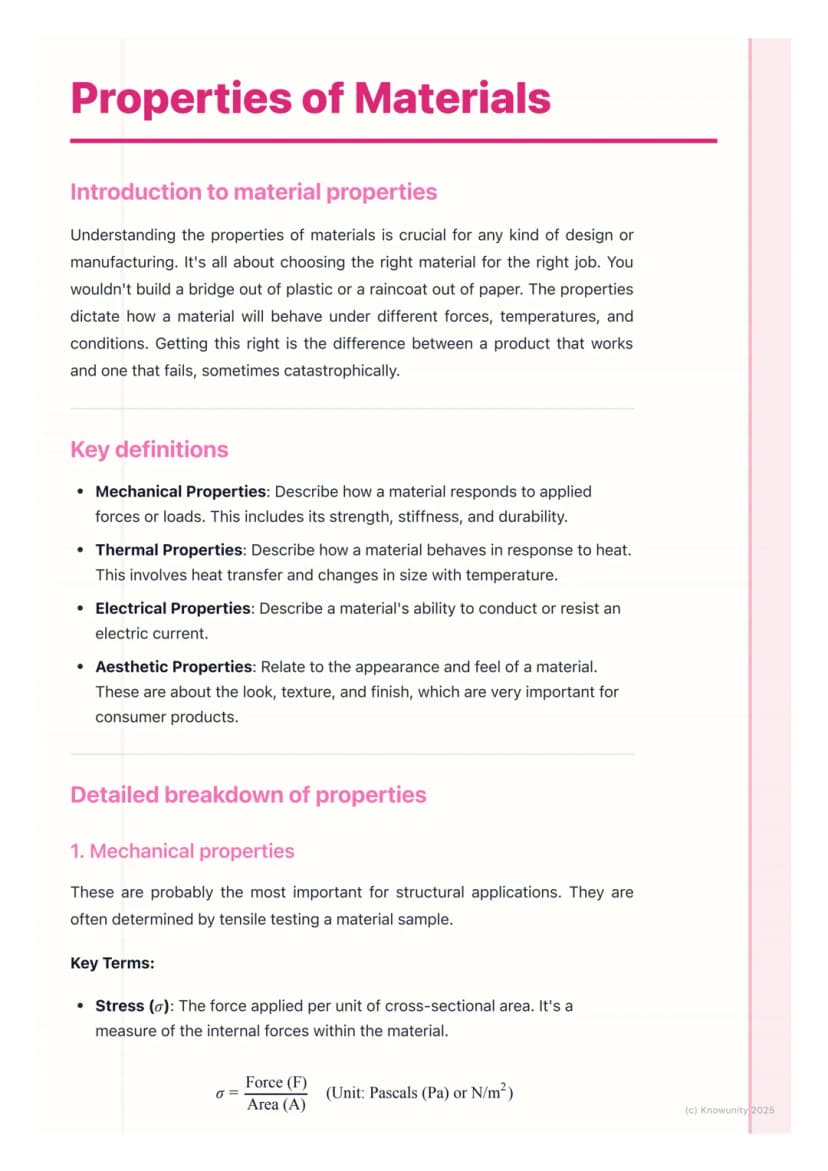
Properties of Materials
Materials science forms the backbone of all engineering and design work. Every time you look at a product, from your phone to a bicycle, someone has carefully selected materials based on their specific properties. Understanding these properties helps you make informed decisions about which materials to use for different applications.
The key properties fall into four main categories:
- Mechanical properties determine how materials respond to forces (like pushing or pulling)
- Thermal properties show how materials react to heat
- Electrical properties describe how materials conduct or resist electricity
- Aesthetic properties cover how materials look and feel
💡 Think of material properties as a material's "personality traits" - just as you wouldn't choose friends based on a single characteristic, engineers don't select materials based on just one property!
The mechanical properties are perhaps the most crucial for structural applications. These properties are typically measured through tensile testing, where samples are pulled until they break. Two fundamental concepts here are stress and strain:
- Stress (σ) = Force/Area (measured in Pascals)
- Strain (ε) = Change in Length/Original Length (no units as it's a ratio)
2
of 6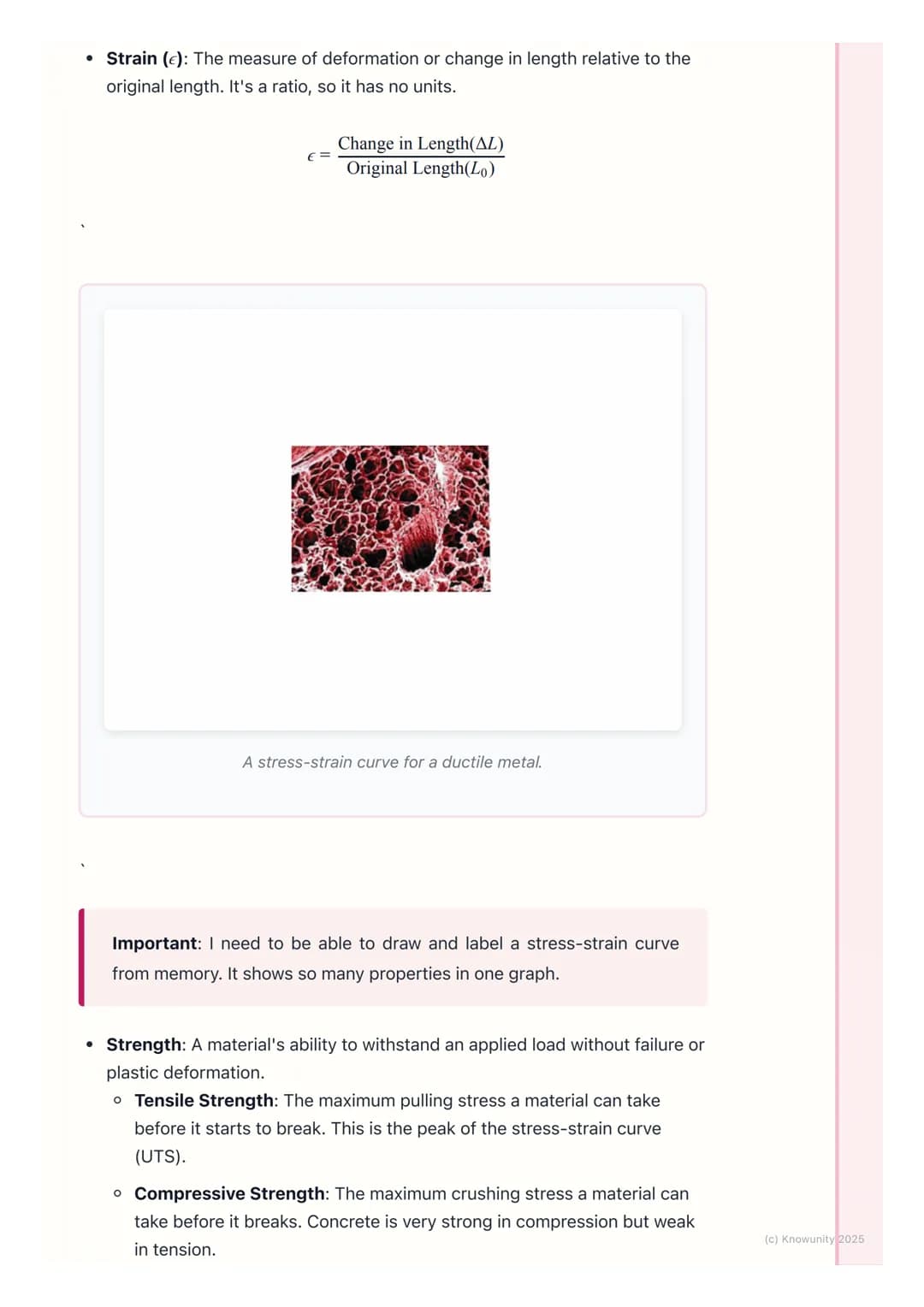
Understanding Material Behavior
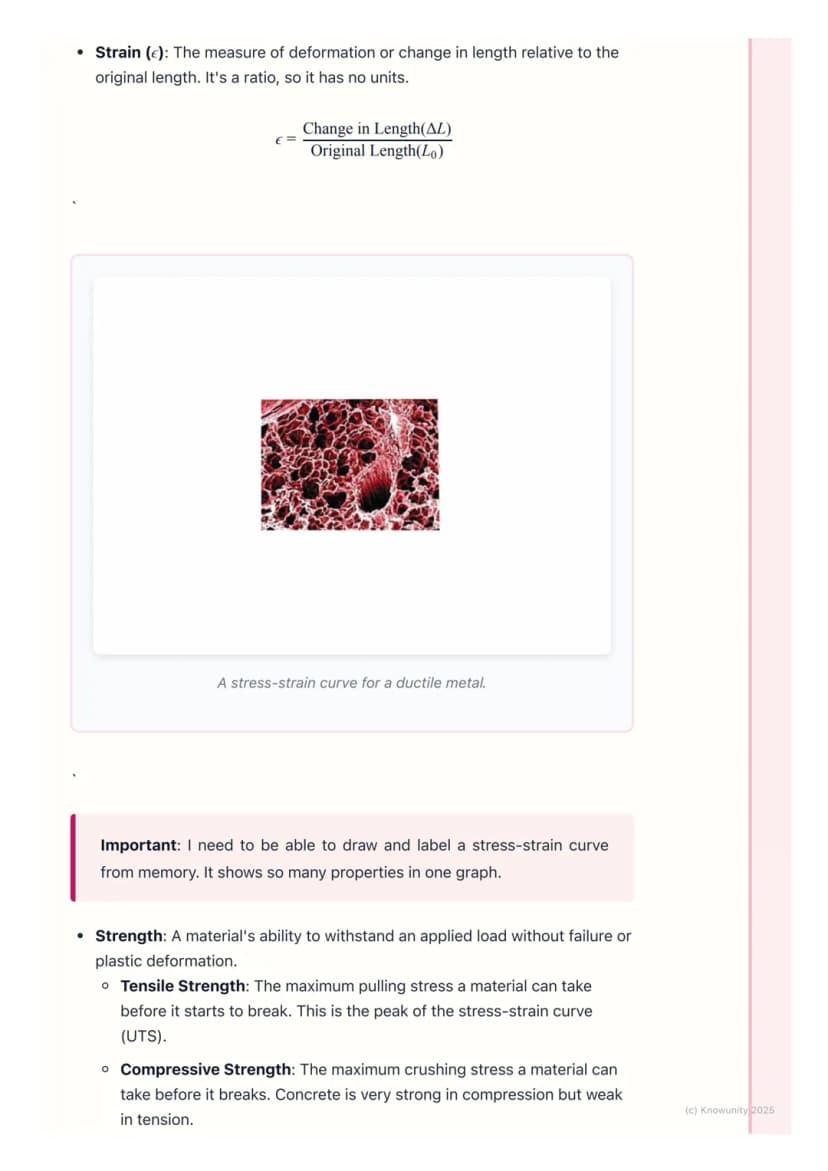
When engineers test materials, they create stress-strain curves that reveal a wealth of information. These graphs show exactly how a material will behave under increasing force, from initial elastic deformation to eventual failure.
The stress-strain curve is like a material's fingerprint. It shows:
- The elastic region where the material will return to its original shape
- The yield point where permanent deformation begins
- The ultimate tensile strength (UTS) at the peak of the curve
- The fracture point where the material finally breaks
Several key mechanical properties emerge from this testing:
-
Strength is a material's ability to withstand forces without failing. This includes tensile strength (resistance to pulling) and compressive strength (resistance to crushing). Concrete, for example, has excellent compressive strength but poor tensile strength.
-
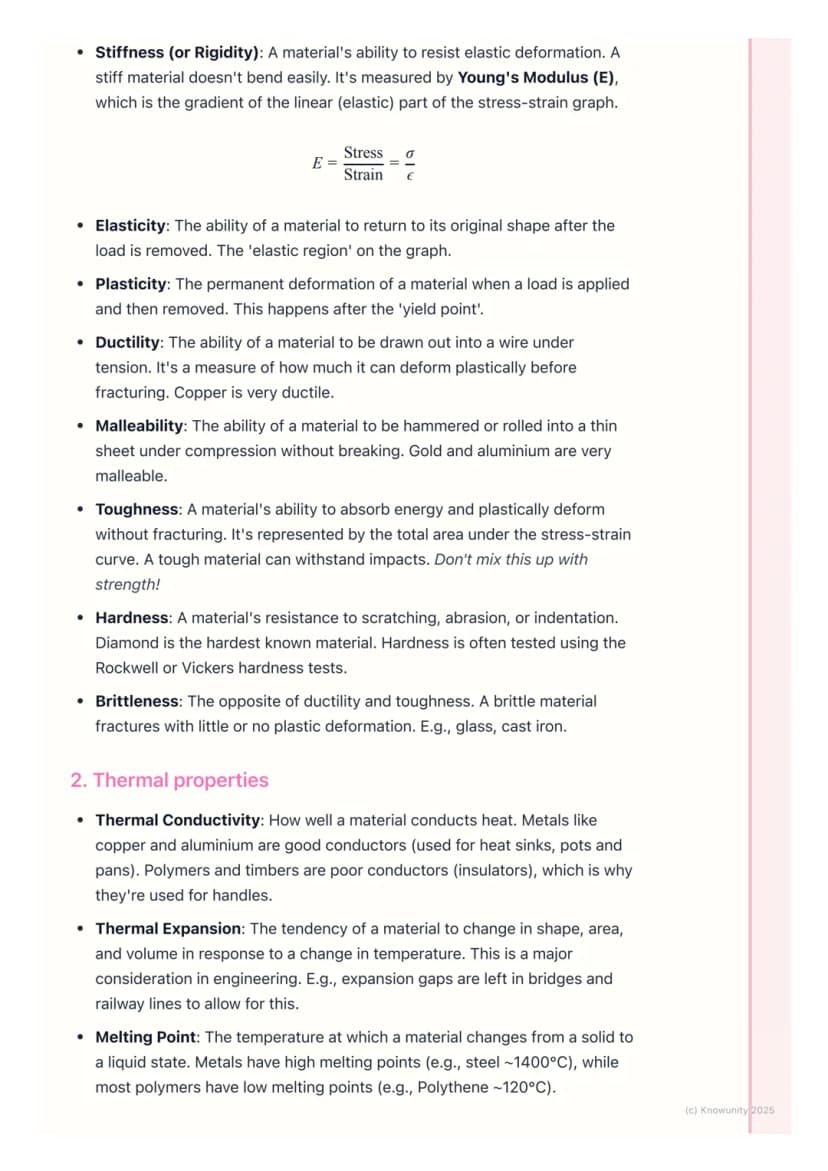
Stiffness measures how much a material resists bending under load. It's quantified by Young's Modulus (E), which is the gradient of the elastic part of the stress-strain curve. A high value means the material is very rigid.
3
of 6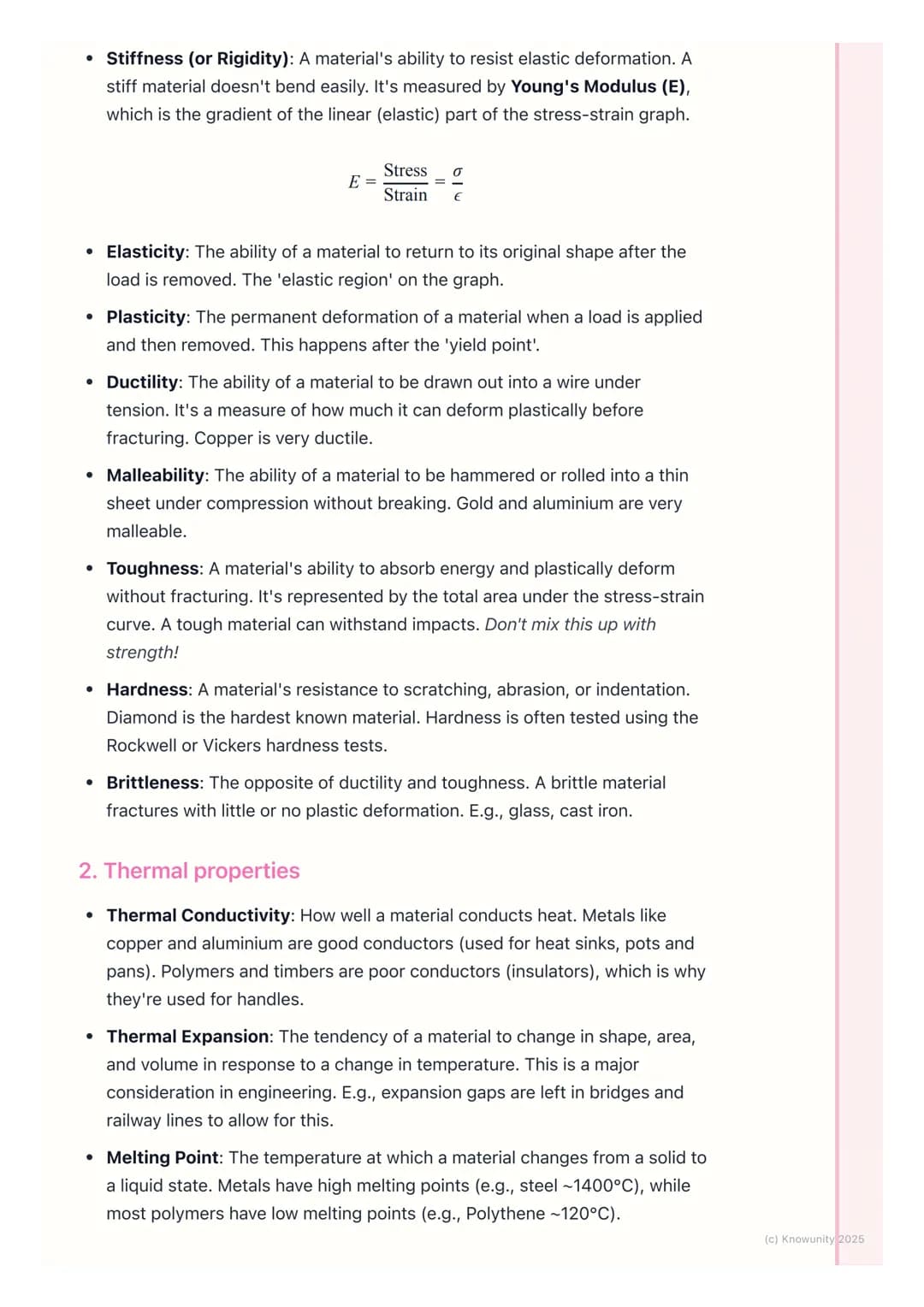
Material Behavior Under Stress
Materials respond differently to forces, and understanding these differences helps you select the right material for specific applications. When examining material behavior, consider these properties:
-
Elasticity describes a material's ability to return to its original shape after a force is removed. Like a rubber band, elastic materials bounce back when the load is gone.
-
Plasticity refers to permanent deformation that remains after a force is removed. This occurs beyond the yield point on a stress-strain curve.
-
Ductility measures how much a material can be stretched into a wire without breaking. Copper has excellent ductility, which is why it's used for electrical wiring.
-
Malleability is similar but relates to a material's ability to be hammered or rolled into sheets. Gold is extremely malleable and can be beaten into sheets just a few atoms thick!
-
Toughness is a material's ability to absorb energy before fracturing. It's represented by the area under the entire stress-strain curve. Tough materials can withstand impacts without breaking.
⚠️ Don't confuse strength with toughness! A strong material resists deformation, while a tough material absorbs energy before breaking. Glass is strong but not tough (it shatters), while rubber is tough but not particularly strong.
Thermal properties are equally important in many applications:
- Thermal conductivity measures how well heat flows through a material
- Thermal expansion describes how materials change size with temperature
- Melting point determines when a solid material becomes liquid
4
of 6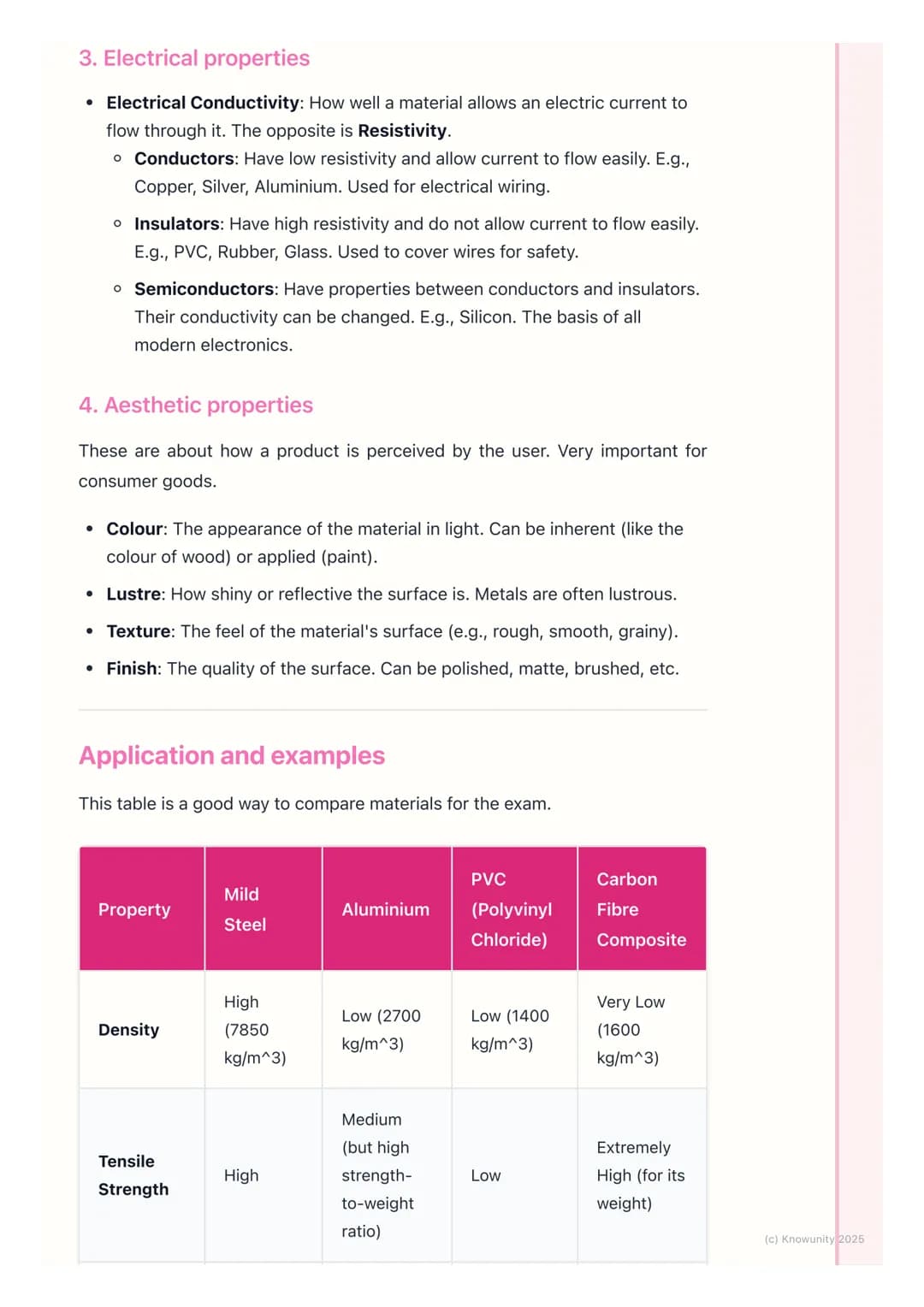
Electrical and Aesthetic Properties
The modern world runs on electricity, making electrical properties vitally important for many applications. Materials fall into three main categories:
Conductors like copper and aluminium allow electricity to flow freely through them. They have low resistance and are used in wiring, circuit boards, and anywhere electricity needs to travel efficiently. Silver is actually the best conductor, but it's too expensive for everyday use!
Insulators like rubber, glass, and most plastics resist electrical flow. They're essential for safety, preventing electric shocks and short circuits. The plastic coating around wires is an insulator that protects you from the conductor inside.
Semiconductors fall between conductors and insulators. Silicon is the most common semiconductor and forms the basis of all computer chips. Their special property is that their conductivity can be precisely controlled.
The aesthetic properties might seem less technical, but they're crucial for consumer products:
- Colour can be inherent to the material or applied as a finish
- Lustre refers to how shiny or reflective a surface is
- Texture describes how a material feels to the touch
- Finish refers to the final surface quality (polished, matte, brushed, etc.)
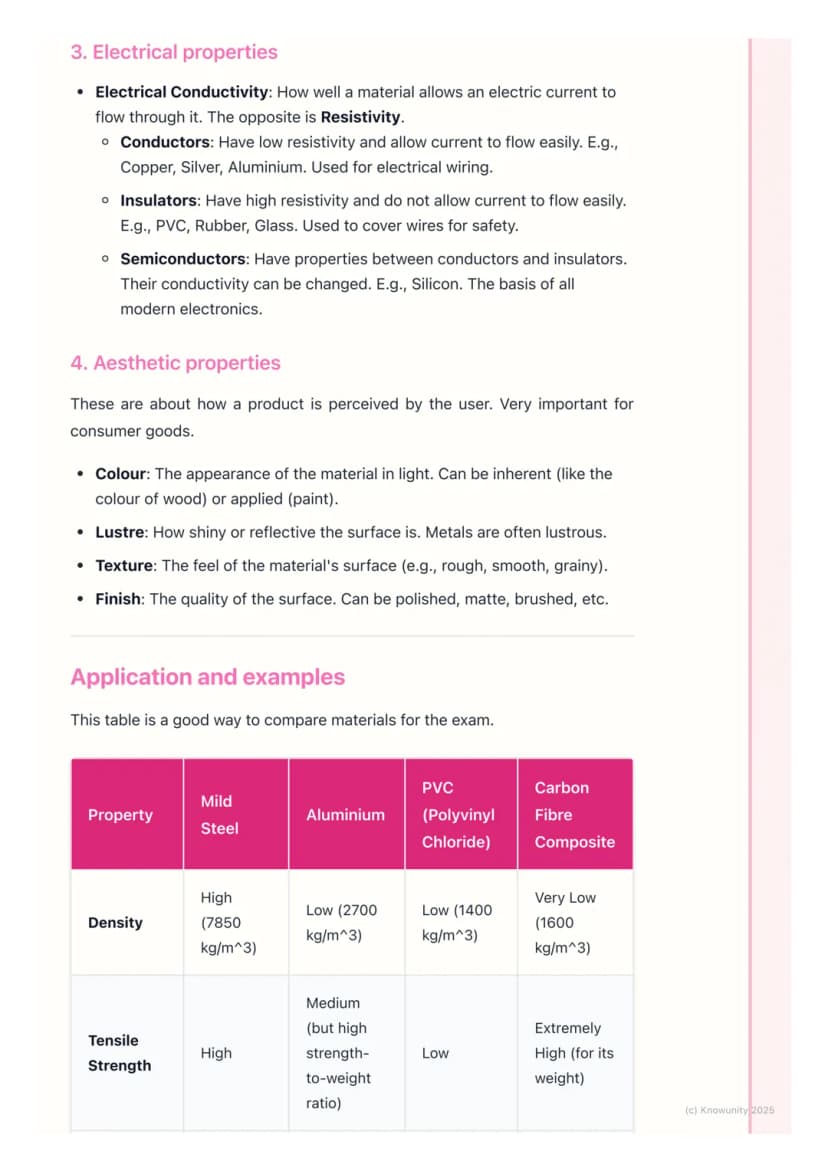
When comparing materials, it helps to look at their properties side by side. For instance, mild steel is dense and strong but heavy, while aluminium is lighter but less stiff. PVC is an electrical insulator with good impact resistance, while carbon fibre offers extraordinary strength-to-weight ratio but is expensive and can fail catastrophically.
5
of 6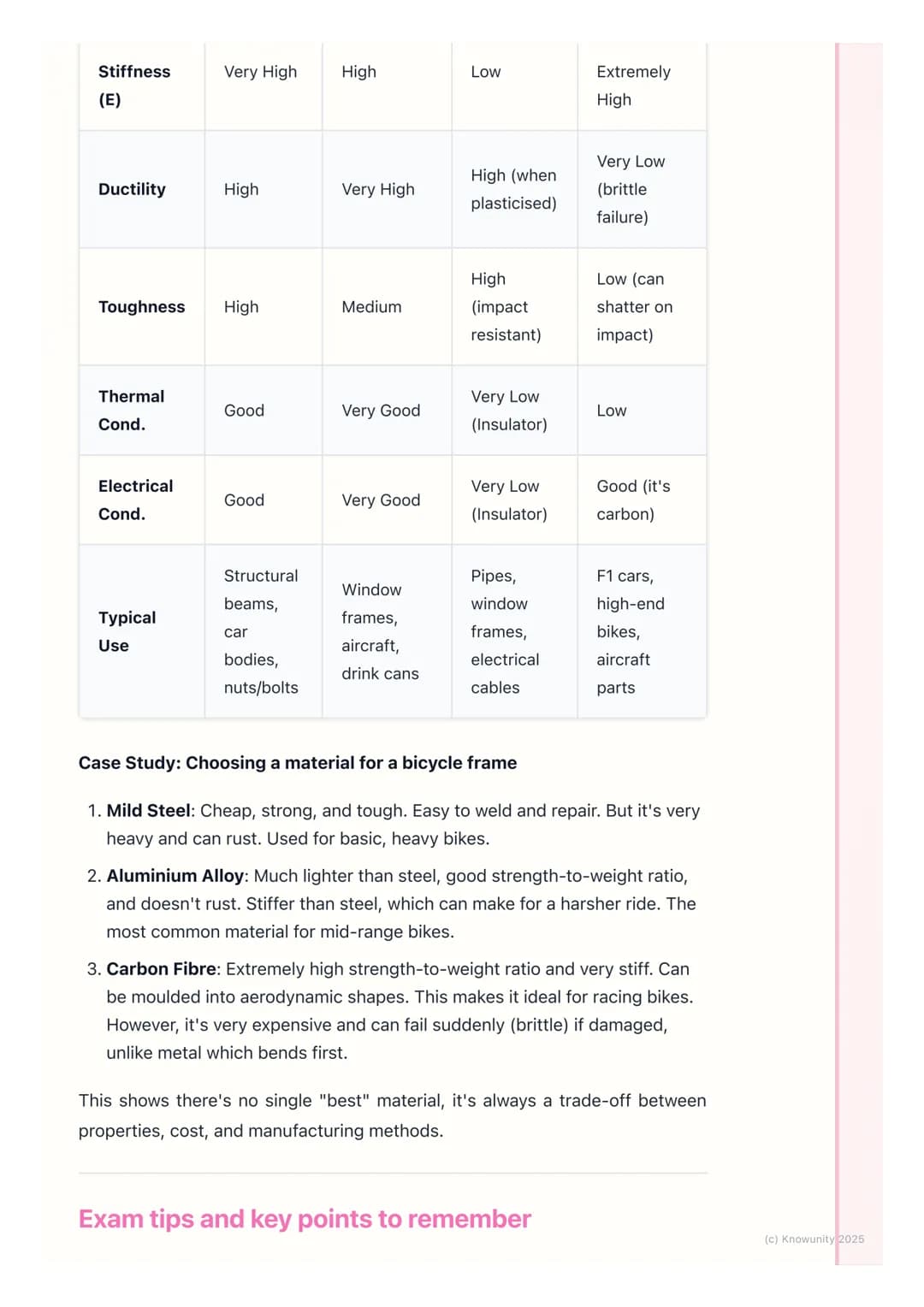
Material Selection in Real Applications
Material selection is always a balancing act between desirable properties, cost, and manufacturing requirements. Let's look at bicycle frames as a practical example:
A steel bike frame is affordable, strong, and relatively easy to repair. If you crash, it will likely bend rather than break. However, it's heavy and susceptible to rust. This makes steel ideal for commuter or touring bikes where reliability matters more than weight.
Aluminium frames are significantly lighter than steel and don't rust. They're stiffer, which transfers power efficiently but can create a harsher ride. Aluminium has become the standard for mid-range bikes because it offers a good balance of weight, strength, and cost.
Carbon fibre frames are extremely lightweight while maintaining exceptional strength. They can be shaped aerodynamically and absorb vibrations well. However, they're expensive, and unlike metals, they can fail suddenly if damaged. This makes them perfect for racing but less ideal for everyday use.
💡 There's no "perfect material" - only the right material for a specific application! The choice always involves trade-offs between properties.
When examining material properties, always consider the specific requirements of your application. A material that's excellent for a kitchen pan handle (poor thermal conductor) would be terrible for a heat sink (needs high thermal conductivity). Similarly, a material perfect for electrical wiring (conductive) would be disastrous for electrical safety equipment (needs to be insulative).
6
of 6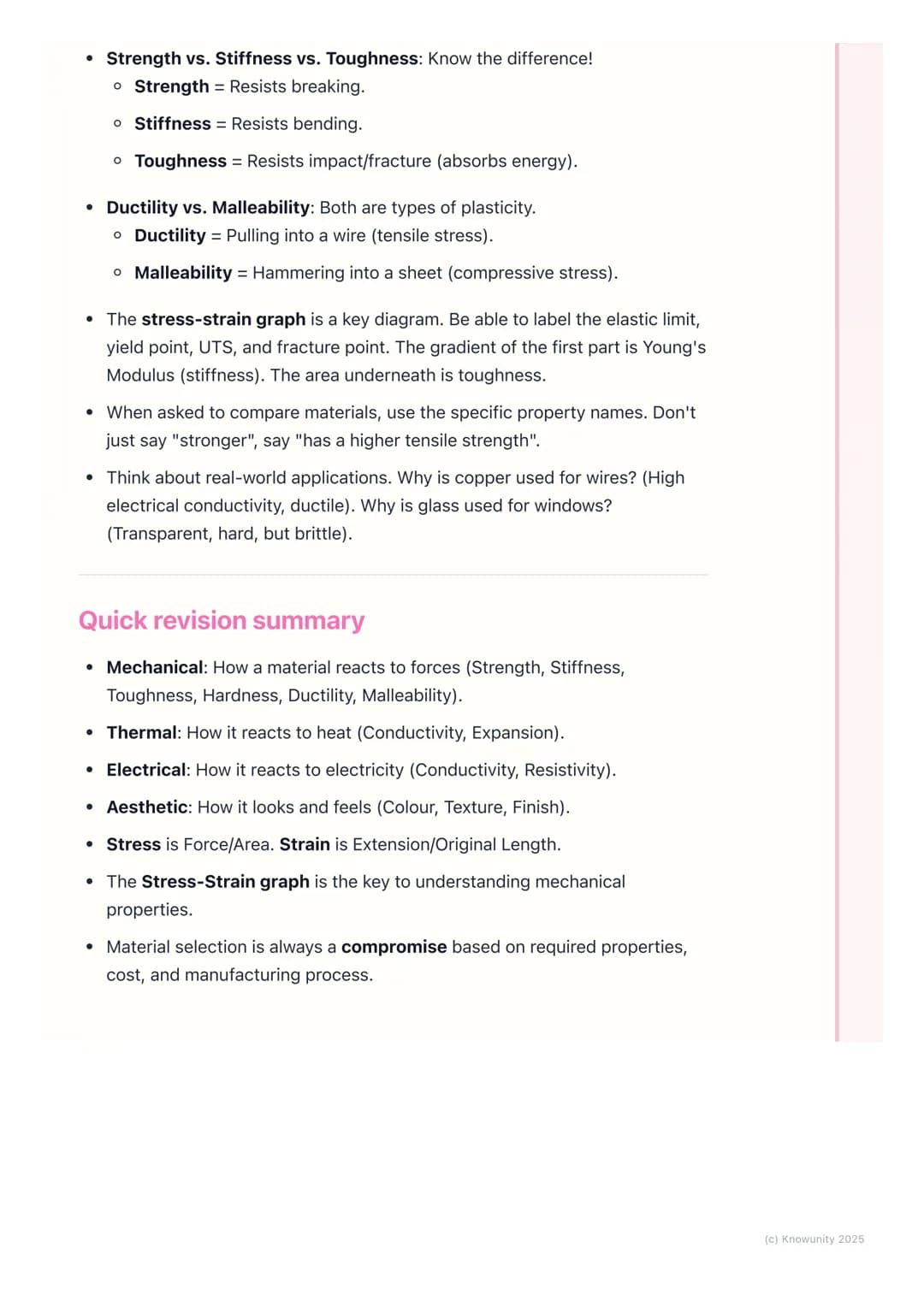
Key Concepts and Exam Tips
Understanding material properties is all about knowing the right terminology and being able to apply concepts to real situations. Here are the critical distinctions you need to remember:
-
Strength vs. Stiffness vs. Toughness: Strength is resistance to breaking, stiffness is resistance to bending, and toughness is resistance to impact fracture.
-
Ductility vs. Malleability: Both involve plastic deformation, but ductility refers to pulling into wire, while malleability refers to hammering into sheets.
The stress-strain graph is your most powerful tool for understanding mechanical properties. Make sure you can:
- Draw and label all key points (elastic limit, yield point, UTS, fracture)
- Identify what each region represents
- Explain what the gradient of the elastic region means (Young's Modulus)
- Describe what the area under the curve represents (toughness)
When answering exam questions about material selection:
- Use specific property terms rather than general descriptions
- Explain why a property makes a material suitable for a particular application
- Consider multiple properties, not just one
- Think about real-world constraints like cost and manufacturing methods
Remember that material selection is always a compromise. Engineers must balance the desired properties against practical considerations like cost, availability, and manufacturability. This is why materials science continues to be one of the most dynamic and innovative fields in engineering.
Pensamos que nunca lo preguntarías...
¿Qué es Knowunity AI companion?
Nuestro compañero de IA está específicamente adaptado a las necesidades de los estudiantes. Basándonos en los millones de contenidos que tenemos en la plataforma, podemos dar a los estudiantes respuestas realmente significativas y relevantes. Pero no se trata solo de respuestas, el compañero también guía a los estudiantes a través de sus retos de aprendizaje diarios, con planes de aprendizaje personalizados, cuestionarios o contenidos en el chat y una personalización del 100% basada en las habilidades y el desarrollo de los estudiantes.
¿Dónde puedo descargar la app Knowunity?
Puedes descargar la app en Google Play Store y Apple App Store.
¿Knowunity es totalmente gratuito?
¡Sí lo es! Tienes acceso totalmente gratuito a todo el contenido de la app, puedes chatear con otros alumnos y recibir ayuda inmeditamente. Puedes ganar dinero utilizando la aplicación, que te permitirá acceder a determinadas funciones.
Contenidos más populares
9 Irish
IrishIrish oral questions and answers
Questions and answers for the leaving cert oral
5th Year4264
 English
Key Quotes : Sive
Key Quotes and explanations: Sive
6th Year2842
IrishIrish oral questions
Outline of oral questions
5th Year2055
IrishIníon- le hÁine Durkin
Aine Durkin’s poem, Iníon: Themes & summary
5th Year850
IrishIrish poetry 2027
Iníon + Dínit an Bhróin
5th Year1133
IrishLC HL notes- Iníon (poem)
Includes poem in English and Irish, theme, key words & phrases
5th Year2284
EnglishCultural Context : Shawshank Redemption : Sive : Small Things Like These
Comparative Study : Cultural Context : Shawshank Redemption, Sive and Small Things Like These
6th Year1430
IrishMo Ghrá-sa (Idir Lúibíní)
Notes on mo ghrá-sa
5th Year380
IrishAn Gaeilge Aiste
Irish Language essay
6th Year1320
¿No encuentras lo que buscas? Explora otros temas.
Mira lo que dicen nuestros usuarios. Les encantó — y a ti también te encantará.
4.6/5App Store
4.7/5Google Play
La app es muy fácil de usar y está muy bien diseñada. Hasta ahora he encontrado todo lo que estaba buscando y he podido aprender mucho de las presentaciones. Definitivamente utilizaré la aplicación para un examen de clase. Y, por supuesto, también me sirve mucho de inspiración.
Pablousuario de iOS
Esta app es realmente genial. Hay tantos apuntes de clase y ayuda [...]. Tengo problemas con matemáticas, por ejemplo, y la aplicación tiene muchas opciones de ayuda. Gracias a Knowunity, he mejorado en mates. Se la recomiendo a todo el mundo.
Elenausuaria de Android
Vaya, estoy realmente sorprendida. Acabo de probar la app porque la he visto anunciada muchas veces y me he quedado absolutamente alucinada. Esta app es LA AYUDA que quieres para el insti y, sobre todo, ofrece muchísimas cosas, como ejercicios y hojas informativas, que a mí personalmente me han sido MUY útiles.
Anausuaria de iOS
Applied Technology4 visualizaciones·Actualizado Jun 8, 2026·6 páginasUnderstanding Material Properties
Understanding material properties is essential for effective design and manufacturing. Materials behave differently under various conditions, and selecting the right one can make the difference between a successful product and a catastrophic failure. These properties determine how materials respond to...
1
of 6
Inscríbete para ver los apuntes. ¡Es gratis!
- Acceso a todos los documentos
- Mejora tus notas
- Únete a millones de estudiantes
Properties of Materials
Materials science forms the backbone of all engineering and design work. Every time you look at a product, from your phone to a bicycle, someone has carefully selected materials based on their specific properties. Understanding these properties helps you make informed decisions about which materials to use for different applications.
The key properties fall into four main categories:
- Mechanical properties determine how materials respond to forces (like pushing or pulling)
- Thermal properties show how materials react to heat
- Electrical properties describe how materials conduct or resist electricity
- Aesthetic properties cover how materials look and feel
💡 Think of material properties as a material's "personality traits" - just as you wouldn't choose friends based on a single characteristic, engineers don't select materials based on just one property!
The mechanical properties are perhaps the most crucial for structural applications. These properties are typically measured through tensile testing, where samples are pulled until they break. Two fundamental concepts here are stress and strain:
- Stress (σ) = Force/Area (measured in Pascals)
- Strain (ε) = Change in Length/Original Length (no units as it's a ratio)
2
of 6Inscríbete para ver los apuntes. ¡Es gratis!
- Acceso a todos los documentos
- Mejora tus notas
- Únete a millones de estudiantes
Understanding Material Behavior
When engineers test materials, they create stress-strain curves that reveal a wealth of information. These graphs show exactly how a material will behave under increasing force, from initial elastic deformation to eventual failure.
The stress-strain curve is like a material's fingerprint. It shows:
- The elastic region where the material will return to its original shape
- The yield point where permanent deformation begins
- The ultimate tensile strength (UTS) at the peak of the curve
- The fracture point where the material finally breaks
Several key mechanical properties emerge from this testing:
-
Strength is a material's ability to withstand forces without failing. This includes tensile strength (resistance to pulling) and compressive strength (resistance to crushing). Concrete, for example, has excellent compressive strength but poor tensile strength.
-
Stiffness measures how much a material resists bending under load. It's quantified by Young's Modulus (E), which is the gradient of the elastic part of the stress-strain curve. A high value means the material is very rigid.
3
of 6Inscríbete para ver los apuntes. ¡Es gratis!
- Acceso a todos los documentos
- Mejora tus notas
- Únete a millones de estudiantes
Material Behavior Under Stress
Materials respond differently to forces, and understanding these differences helps you select the right material for specific applications. When examining material behavior, consider these properties:
-
Elasticity describes a material's ability to return to its original shape after a force is removed. Like a rubber band, elastic materials bounce back when the load is gone.
-
Plasticity refers to permanent deformation that remains after a force is removed. This occurs beyond the yield point on a stress-strain curve.
-
Ductility measures how much a material can be stretched into a wire without breaking. Copper has excellent ductility, which is why it's used for electrical wiring.
-
Malleability is similar but relates to a material's ability to be hammered or rolled into sheets. Gold is extremely malleable and can be beaten into sheets just a few atoms thick!
-
Toughness is a material's ability to absorb energy before fracturing. It's represented by the area under the entire stress-strain curve. Tough materials can withstand impacts without breaking.
⚠️ Don't confuse strength with toughness! A strong material resists deformation, while a tough material absorbs energy before breaking. Glass is strong but not tough (it shatters), while rubber is tough but not particularly strong.
Thermal properties are equally important in many applications:
- Thermal conductivity measures how well heat flows through a material
- Thermal expansion describes how materials change size with temperature
- Melting point determines when a solid material becomes liquid
4
of 6Inscríbete para ver los apuntes. ¡Es gratis!
- Acceso a todos los documentos
- Mejora tus notas
- Únete a millones de estudiantes
Electrical and Aesthetic Properties
The modern world runs on electricity, making electrical properties vitally important for many applications. Materials fall into three main categories:
Conductors like copper and aluminium allow electricity to flow freely through them. They have low resistance and are used in wiring, circuit boards, and anywhere electricity needs to travel efficiently. Silver is actually the best conductor, but it's too expensive for everyday use!
Insulators like rubber, glass, and most plastics resist electrical flow. They're essential for safety, preventing electric shocks and short circuits. The plastic coating around wires is an insulator that protects you from the conductor inside.
Semiconductors fall between conductors and insulators. Silicon is the most common semiconductor and forms the basis of all computer chips. Their special property is that their conductivity can be precisely controlled.
The aesthetic properties might seem less technical, but they're crucial for consumer products:
- Colour can be inherent to the material or applied as a finish
- Lustre refers to how shiny or reflective a surface is
- Texture describes how a material feels to the touch
- Finish refers to the final surface quality (polished, matte, brushed, etc.)
When comparing materials, it helps to look at their properties side by side. For instance, mild steel is dense and strong but heavy, while aluminium is lighter but less stiff. PVC is an electrical insulator with good impact resistance, while carbon fibre offers extraordinary strength-to-weight ratio but is expensive and can fail catastrophically.
5
of 6Inscríbete para ver los apuntes. ¡Es gratis!
- Acceso a todos los documentos
- Mejora tus notas
- Únete a millones de estudiantes
Material Selection in Real Applications
Material selection is always a balancing act between desirable properties, cost, and manufacturing requirements. Let's look at bicycle frames as a practical example:
A steel bike frame is affordable, strong, and relatively easy to repair. If you crash, it will likely bend rather than break. However, it's heavy and susceptible to rust. This makes steel ideal for commuter or touring bikes where reliability matters more than weight.
Aluminium frames are significantly lighter than steel and don't rust. They're stiffer, which transfers power efficiently but can create a harsher ride. Aluminium has become the standard for mid-range bikes because it offers a good balance of weight, strength, and cost.
Carbon fibre frames are extremely lightweight while maintaining exceptional strength. They can be shaped aerodynamically and absorb vibrations well. However, they're expensive, and unlike metals, they can fail suddenly if damaged. This makes them perfect for racing but less ideal for everyday use.
💡 There's no "perfect material" - only the right material for a specific application! The choice always involves trade-offs between properties.
When examining material properties, always consider the specific requirements of your application. A material that's excellent for a kitchen pan handle (poor thermal conductor) would be terrible for a heat sink (needs high thermal conductivity). Similarly, a material perfect for electrical wiring (conductive) would be disastrous for electrical safety equipment (needs to be insulative).
6
of 6Inscríbete para ver los apuntes. ¡Es gratis!
- Acceso a todos los documentos
- Mejora tus notas
- Únete a millones de estudiantes
Key Concepts and Exam Tips
Understanding material properties is all about knowing the right terminology and being able to apply concepts to real situations. Here are the critical distinctions you need to remember:
-
Strength vs. Stiffness vs. Toughness: Strength is resistance to breaking, stiffness is resistance to bending, and toughness is resistance to impact fracture.
-
Ductility vs. Malleability: Both involve plastic deformation, but ductility refers to pulling into wire, while malleability refers to hammering into sheets.
The stress-strain graph is your most powerful tool for understanding mechanical properties. Make sure you can:
- Draw and label all key points (elastic limit, yield point, UTS, fracture)
- Identify what each region represents
- Explain what the gradient of the elastic region means (Young's Modulus)
- Describe what the area under the curve represents (toughness)
When answering exam questions about material selection:
- Use specific property terms rather than general descriptions
- Explain why a property makes a material suitable for a particular application
- Consider multiple properties, not just one
- Think about real-world constraints like cost and manufacturing methods
Remember that material selection is always a compromise. Engineers must balance the desired properties against practical considerations like cost, availability, and manufacturability. This is why materials science continues to be one of the most dynamic and innovative fields in engineering.
Pensamos que nunca lo preguntarías...
¿Qué es Knowunity AI companion?
Nuestro compañero de IA está específicamente adaptado a las necesidades de los estudiantes. Basándonos en los millones de contenidos que tenemos en la plataforma, podemos dar a los estudiantes respuestas realmente significativas y relevantes. Pero no se trata solo de respuestas, el compañero también guía a los estudiantes a través de sus retos de aprendizaje diarios, con planes de aprendizaje personalizados, cuestionarios o contenidos en el chat y una personalización del 100% basada en las habilidades y el desarrollo de los estudiantes.
¿Dónde puedo descargar la app Knowunity?
Puedes descargar la app en Google Play Store y Apple App Store.
¿Knowunity es totalmente gratuito?
¡Sí lo es! Tienes acceso totalmente gratuito a todo el contenido de la app, puedes chatear con otros alumnos y recibir ayuda inmeditamente. Puedes ganar dinero utilizando la aplicación, que te permitirá acceder a determinadas funciones.
Contenidos más populares
9IrishIrish oral questions and answers
Questions and answers for the leaving cert oral
5th Year4264
EnglishKey Quotes : Sive
Key Quotes and explanations: Sive
6th Year2842
IrishIrish oral questions
Outline of oral questions
5th Year2055
IrishIníon- le hÁine Durkin
Aine Durkin’s poem, Iníon: Themes & summary
5th Year850
IrishIrish poetry 2027
Iníon + Dínit an Bhróin
5th Year1133
IrishLC HL notes- Iníon (poem)
Includes poem in English and Irish, theme, key words & phrases
5th Year2284
EnglishCultural Context : Shawshank Redemption : Sive : Small Things Like These
Comparative Study : Cultural Context : Shawshank Redemption, Sive and Small Things Like These
6th Year1430
IrishMo Ghrá-sa (Idir Lúibíní)
Notes on mo ghrá-sa
5th Year380
IrishAn Gaeilge Aiste
Irish Language essay
6th Year1320
¿No encuentras lo que buscas? Explora otros temas.
Mira lo que dicen nuestros usuarios. Les encantó — y a ti también te encantará.
4.6/5App Store
4.7/5Google Play
La app es muy fácil de usar y está muy bien diseñada. Hasta ahora he encontrado todo lo que estaba buscando y he podido aprender mucho de las presentaciones. Definitivamente utilizaré la aplicación para un examen de clase. Y, por supuesto, también me sirve mucho de inspiración.
Pablousuario de iOS
Esta app es realmente genial. Hay tantos apuntes de clase y ayuda [...]. Tengo problemas con matemáticas, por ejemplo, y la aplicación tiene muchas opciones de ayuda. Gracias a Knowunity, he mejorado en mates. Se la recomiendo a todo el mundo.
Elenausuaria de Android
Vaya, estoy realmente sorprendida. Acabo de probar la app porque la he visto anunciada muchas veces y me he quedado absolutamente alucinada. Esta app es LA AYUDA que quieres para el insti y, sobre todo, ofrece muchísimas cosas, como ejercicios y hojas informativas, que a mí personalmente me han sido MUY útiles.
Anausuaria de iOS